The Haunting Charm of Fisher Price My First Séance: A Playtime Paranormal Adventure
The Fisher Price My First Séance is not merely a toy—it is a cultural artifact, a playful riddle wrapped in plastic, designed to whisper secrets to the ears of toddlers. Released in the early 1990s as part of Fisher Price’s Little People line, this eerie little board game invited children to "communicate with the spirit world" through a series of dice rolls, ghostly tokens, and a Ouija Wheel-style pointer. Its premise was simple: roll the dice, move the spirit token, and let the "spirits" guide you. Yet beneath its whimsical surface lay a deeper conversation about childhood imagination, the macabre, and the boundaries of play. Why did a company known for nurturing early learning embrace the occult? And how did this toy reflect broader societal shifts in parenting, entertainment, and the blurred lines between fantasy and reality?
The My First Séance was never just about séances. It was a gateway—a toy that taught children about probability (via dice mechanics), storytelling (through ghostly scenarios), and even social interaction (as siblings or parents "joined the séance"). Its design, with its pastel-colored ghosts and oversized dice, softened the edges of the supernatural, making it palatable for preschoolers. Yet critics questioned its appropriateness: Was it too dark for little hands? Or was it, in fact, a brilliant exercise in controlled spookiness, a way to introduce children to fear in a structured, toy-box-safe environment? The debate revealed how toys like this one straddle the line between innocence and intrigue, forcing parents and educators to confront what they deemed "age-appropriate."
What makes the Fisher Price My First Séance particularly fascinating is its timing. The 1990s were a decade of growing fascination with the occult—from Sabrina the Teenage Witch to The X-Files—yet children’s toys rarely ventured into such territory. Fisher Price, a brand synonymous with safety and education, took a calculated risk. The toy’s success (or limited lifespan) speaks volumes about how society views childhood and the supernatural. Was it a fleeting trend, or a harbinger of a new era in play? To answer that, we must examine its origins, mechanics, and the cultural currents it rode—or drowned in.
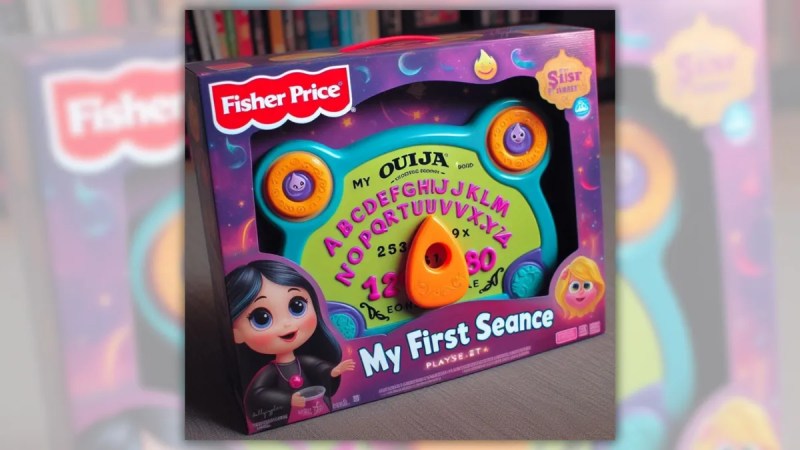
The Complete Overview of Fisher Price My First Séance
The Fisher Price My First Séance was a limited-edition board game released in the early 1990s, targeting children aged 3–5. Unlike traditional Fisher Price products focused on early literacy or motor skills, this toy leaned into the fantastical, offering a "spooky" experience without the horror. The game’s premise was deceptively simple: players rolled a die to move a ghostly token around a circular board, answering questions posed by the "spirits" (represented by illustrated ghosts with exaggerated eyes and grins). The goal wasn’t competition but collaboration—children were encouraged to work together to "contact" the spirits, who would then "reveal" answers to their questions (e.g., "What’s your favorite color?" or "Where do ghosts sleep?").What set the My First Séance apart was its duality. On one hand, it was a playful introduction to the supernatural, stripping away the dread of real séances and replacing it with cartoonish charm. The ghosts were friendly, the mechanics were straightforward, and the stakes were nonexistent. On the other hand, it tapped into a primal curiosity about the afterlife, death, and the unknown—topics often avoided in children’s media. Fisher Price’s decision to market this as an "educational" toy in spirit (pun intended) was telling. The company framed it as a tool for imaginative play, social skills, and even emotional processing, arguing that children could safely explore their fears through structured, supervised gameplay.
Historical Background and Evolution
The Fisher Price My First Séance emerged during a period when children’s toys were increasingly reflecting adult interests in the paranormal. The 1980s and early 1990s saw a surge in occult-themed media, from Ghostbusters to The Chilling Adventures of Sabrina, yet children’s toys remained largely sanitized. Fisher Price’s foray into the supernatural was bold, but not entirely unprecedented. The company had dabbled in macabre themes before, such as the Little People line’s occasional "monster" characters, but nothing as directly tied to séances. The timing was strategic: parents in the '90s were more open to exposing children to "scary" but controlled experiences, thanks in part to the rise of Halloween as a mainstream holiday.The toy’s design was a masterclass in accessibility. The board was circular, eliminating the need for complex rules, and the dice were oversized for little fingers. The ghosts were designed with exaggerated features—big eyes, toothy grins—to ensure they felt more whimsical than terrifying. Fisher Price even included a "spirit guide" card that parents could use to narrate the game, adding an interactive layer. Despite its playful approach, the My First Séance was short-lived, disappearing from shelves by the mid-'90s. Some speculate it was a victim of its own success—parents and educators found it too divisive, while others argue it simply didn’t align with Fisher Price’s core brand identity. Either way, its brief existence remains a curiosity in toy history.
Core Mechanisms: How It Works
At its core, the Fisher Price My First Séance functioned like a simplified Ouija board, but with the safety nets of a children’s game. Players began by placing a ghost token on the "spirit circle" at the center of the board. They then rolled a die to determine how many spaces to move the token clockwise. Each space corresponded to a question or prompt, such as "Ask the spirits about your birthday" or "What’s your favorite toy?" The "spirits" would then "respond" by pointing the ghost token to a pre-determined answer (e.g., "A red balloon!" or "Your teddy bear!").Table of Contents
- The Complete Overview of Fisher Price My First Séance
- Historical Background and Evolution
- Core Mechanisms: How It Works
- Key Benefits and Crucial Impact
- Major Advantages
- Comparative Analysis
- Future Trends and Innovations
- Conclusion
- Comprehensive FAQs
- Q: Is the Fisher Price My First Séance still available for purchase?
- Q: Was the toy ever recalled or criticized for being too scary?
- Q: How did the game’s mechanics differ from a real Ouija board?
- Q: Did Fisher Price release other "spooky" toys like this?
- Q: Could this toy be used for therapeutic purposes?
- Q: Are there modern alternatives to the Fisher Price My First Séance?
- Q: Why did Fisher Price stop making this toy?
The mechanics were intentionally loose, allowing for creative interpretation. There was no "winning" or "losing"—just exploration. This aligns with modern child development theories that emphasize open-ended play over structured competition. The toy also encouraged verbal interaction, as children took turns asking questions and "listening" to the spirits’ answers. The lack of a fixed end goal made it adaptable for different skill levels, though younger children might need guidance from adults. The simplicity of the design ensured that the focus remained on imagination rather than complexity, a hallmark of Fisher Price’s approach to early learning.
Key Benefits and Crucial Impact
The Fisher Price My First Séance was more than a novelty—it was a tool for emotional and cognitive development. By framing the supernatural as a game, it allowed children to confront abstract concepts like death, the unknown, and even fear in a controlled setting. Studies in developmental psychology suggest that structured play with "scary" themes can help children process anxieties, and this toy did precisely that. It also fostered social skills, as siblings or parents could join in, creating shared experiences. The collaborative nature of the game mirrored real-world interactions, teaching turn-taking and communication.Yet its impact extended beyond the playroom. The toy sparked conversations about appropriate content for young children, challenging the notion that all play must be purely wholesome. Some educators praised it for its imaginative potential, while others warned against normalizing occult themes. Fisher Price’s decision to market it as an "educational" toy—albeit in spirit—highlighted the company’s willingness to push boundaries. The debate surrounding the My First Séance reflected broader cultural tensions about childhood, media, and the role of toys in shaping young minds.
"Play is the highest form of research." —Albert Einstein
While Einstein wasn’t referring to séances, the Fisher Price My First Séance embodied this idea. It turned curiosity into a game, fear into fun, and the unknown into a shared adventure. The toy’s legacy lies not in its sales figures but in the questions it provoked: How much should children be exposed to the macabre? Can play be both educational and spooky? And perhaps most importantly—what do we learn when we let kids "talk to the spirits"?
Major Advantages
- Emotional Processing: The toy provided a safe space for children to explore fears and the unknown, using play as a coping mechanism.
- Social Interaction: Designed for group play, it encouraged collaboration and turn-taking, fostering early social skills.
- Imaginative Development: Open-ended questions and responses allowed children to create their own narratives, enhancing creativity.
- Cognitive Simplicity: The straightforward mechanics made it accessible for young children, requiring minimal reading or complex rules.
- Cultural Relevance: Its release during the '90s occult boom made it a reflection of broader media trends, blending nostalgia with innovation.

Comparative Analysis
| Fisher Price My First Séance | Traditional Fisher Price Toys |
|---|---|
| Occult-themed, designed for imaginative play and emotional exploration. | Focused on early learning (letters, numbers, motor skills) with no supernatural elements. |
| Collaborative, open-ended gameplay with no "winner." | Often competitive or skill-based (e.g., memory games, puzzles). |
| Short-lived due to divisive reception; limited re-releases. | Long-standing classics with consistent demand (e.g., Little People, Smart Cycle). |
| Targeted emotional and social development alongside fun. | Primarily focused on academic and motor skill development. |
Future Trends and Innovations
The Fisher Price My First Séance remains a fascinating case study in how toys can evolve to meet cultural shifts. Today, as interest in the occult and alternative spirituality grows among younger generations, there’s potential for similar toys to re-emerge—but with modern twists. Imagine a My First Séance app, where augmented reality brings ghosts to life, or a version that incorporates mindfulness and emotional regulation. The key would be balancing nostalgia with contemporary concerns, such as screen time and mental health.Another trend to watch is the rise of "dark academia" and gothic aesthetics in children’s media, from Wednesday to Goosebumps reboots. Toys that blend spookiness with education—like coding games disguised as haunted houses—could follow in the My First Séance’s footsteps. The challenge will be ensuring these toys remain age-appropriate while still captivating imaginations. Fisher Price’s experiment with the supernatural was ahead of its time, and future iterations might just refine its approach, proving that sometimes, the scariest things in childhood are the ones that teach us the most.

Conclusion
The Fisher Price My First Séance was a bold experiment—a toy that dared to whisper to children about the unseen while keeping them firmly in the land of the living. Its brief run on shelves tells us as much about the '90s as it does about Fisher Price’s willingness to innovate. Was it a misstep or a masterstroke? Perhaps both. The toy’s legacy lies in the conversations it sparked: about fear, play, and the blurred lines between childhood and the unknown. In an era where toys are increasingly tailored to educational goals, the My First Séance reminds us that sometimes, the best lessons come from letting kids believe in magic—even if that magic is just a ghostly token on a board.As for its future, the Fisher Price My First Séance may never return in its original form, but its spirit lives on in the toys that dare to be different. Whether through AR séances, mindfulness-infused spooky play, or new interpretations of the occult for kids, the demand for toys that balance fun with depth remains. The My First Séance wasn’t just a game—it was a mirror, reflecting the curiosities and anxieties of a generation. And in that reflection, we see the enduring power of play to turn the unknown into something wondrous.
Comprehensive FAQs
Q: Is the Fisher Price My First Séance still available for purchase?
The original My First Séance is long out of production, but vintage copies occasionally surface on eBay, Etsy, or at toy collector markets. Fisher Price has not re-released it, though similar occult-themed children’s games (like Ouija Junior) exist today.
Q: Was the toy ever recalled or criticized for being too scary?
While there were no official recalls, some parents and educators expressed concerns about its macabre themes. Fisher Price framed it as a tool for imaginative play, but the debate highlights how toys that push boundaries often face scrutiny.
Q: How did the game’s mechanics differ from a real Ouija board?
The My First Séance simplified Ouija mechanics by using dice and a circular board, eliminating the need for a planchette. It also included guided questions and answers, making it safer and more structured for young children.
Q: Did Fisher Price release other "spooky" toys like this?
Not to the same extent. While the Little People line occasionally featured monsters or Halloween-themed sets, the My First Séance remains one of the few direct forays into the supernatural for Fisher Price.
Q: Could this toy be used for therapeutic purposes?
Some child psychologists might argue that its structured, collaborative approach could help children process fears or anxieties. However, it was never marketed as a therapeutic tool—its primary purpose was imaginative play.
Q: Are there modern alternatives to the Fisher Price My First Séance?
Yes. Toys like Ouija Junior, Ghosts in the Graveyard (a board game), or even apps that simulate séances offer similar experiences. However, none replicate the My First Séance’s specific blend of simplicity and spookiness.
Q: Why did Fisher Price stop making this toy?
The exact reasons are unclear, but factors likely included limited market demand, parental concerns, and Fisher Price’s focus on educational toys. Its niche appeal may have made it unsustainable for mass production.
Leave a Comment
Comments are moderated before appearing. The data you submit is processed according to the Privacy Policy of Bevvy.