The Exact Answer: How Many Oz in a Quart (And Why It Matters)
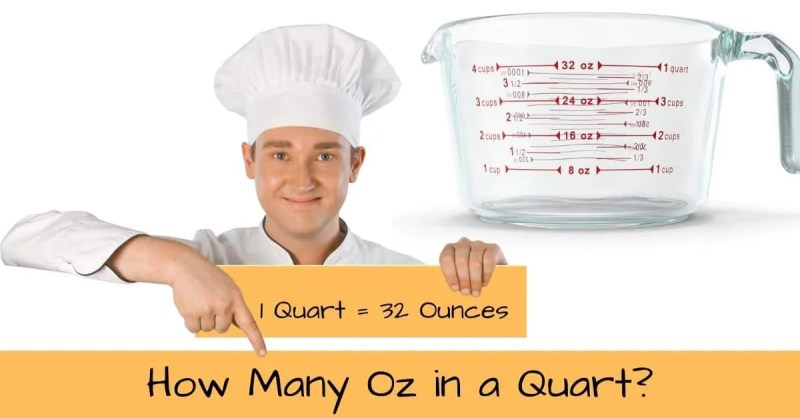
The relationship between ounces and quarts is one of those deceptively simple conversions that trips up even seasoned professionals. Whether you're scaling a recipe, calibrating industrial equipment, or simply verifying a measurement, knowing how many ounces fit into a quart isn’t just about memorization—it’s about precision. The answer, at its core, is 32 fluid ounces in a quart, but the nuances—like the difference between US and imperial standards—can turn a straightforward question into a labyrinth of units. This discrepancy isn’t just academic; it affects everything from pharmaceutical dosing to home brewing, where a miscalculation could mean wasted ingredients or compromised safety.
The confusion often stems from the dual systems of measurement still in use today: the US customary system and the imperial system (used primarily in the UK). While both define a quart as 32 fluid ounces, the actual volume each represents differs slightly due to historical adjustments. For instance, a US liquid quart measures 57.75 cubic inches, whereas an imperial quart is 69.35 cubic inches. This might seem trivial until you’re comparing a British baking recipe to an American one—suddenly, your soufflé’s rise depends on whether you’re using the right "quart."
Even within the US, the distinction between fluid ounces and weight ounces adds another layer. A fluid ounce measures volume (e.g., liquids), while an ounce of weight measures mass (e.g., dry ingredients like flour). Mixing these up could lead to disastrous results—imagine pouring 32 weight ounces of water (which is roughly 35.2 fluid ounces) into a quart container. The overflow wouldn’t just be messy; it could invalidate an entire experiment or production batch.

The Complete Overview of How Many Oz in a Quart
At its most fundamental, the conversion between quarts and ounces is a cornerstone of volumetric measurement, yet its practical applications extend far beyond basic arithmetic. Understanding this relationship isn’t just about reciting "32 oz = 1 quart"—it’s about grasping how these units interact in real-world scenarios, from culinary precision to scientific accuracy. The quart, as a unit, traces its origins to the Latin quattuor, meaning "four," originally referencing a quarter of a gallon. Over centuries, its definition evolved alongside trade and industry, adapting to regional needs while retaining a core structure that remains consistent across most English-speaking countries.The fluid ounce, meanwhile, has undergone its own transformations. In the 19th century, the US standardized its fluid ounce to 1.80469 cubic inches, while the imperial system retained 1.7339 cubic inches. This divergence might seem negligible, but in fields like pharmacology or aviation, where measurements must be exact, even a fraction of an inch can have critical consequences. For example, a pilot calculating fuel consumption or a chemist mixing solvents relies on these precise definitions to avoid errors that could compromise safety or efficiency.
Historical Background and Evolution
The quart’s history is deeply intertwined with the development of trade and commerce. By the 13th century, English brewers and merchants used the "quarter" as a practical unit for measuring beer and ale, which was then taxed by volume. The Weights and Measures Act of 1824 in the UK formalized the imperial quart, tying it to the gallon—a unit derived from the volume of 10 pounds of water at 62°F. Meanwhile, the US, after gaining independence, began refining its own system, leading to the Metric Conversion Act of 1866, which attempted (though imperfectly) to align American measurements with international standards.The fluid ounce’s evolution reflects similar practical concerns. Early definitions varied widely—some regions used wine glasses or specific containers as references. It wasn’t until the 19th century that the US and UK settled on their respective standards, though the imperial system retained a slightly larger ounce to accommodate older trade practices. This historical context explains why, today, a US quart and an imperial quart aren’t interchangeable without adjustment. For instance, a British recipe calling for a quart of milk might yield less in the US due to the volume difference, even though both systems claim "32 oz."
Core Mechanisms: How It Works
The conversion between quarts and ounces operates on a hierarchical structure within the US customary and imperial systems. Both systems define:Table of Contents
- The Complete Overview of How Many Oz in a Quart
- Historical Background and Evolution
- Core Mechanisms: How It Works
- Key Benefits and Crucial Impact
- Major Advantages
- Comparative Analysis
- Future Trends and Innovations
- Conclusion
- Comprehensive FAQs
- Q: Why do the US and imperial quarts have different volumes if they both equal 32 oz?
- Q: Can I use a US quart measurement in an imperial recipe without adjusting?
- Q: How do I convert quarts to ounces for dry ingredients like flour?
- Q: Are there any countries that use both US and imperial quarts?
- Q: What’s the easiest way to remember how many oz are in a quart?
- Q: How does this conversion apply in metric terms?
- Q: Why do some recipes list "fluid oz" and others just "oz"?
- Q: Are there any industries where this conversion is critical?
However, the physical volume each unit occupies differs due to the systems’ divergent definitions. The US fluid ounce is 1/128 of a US gallon, while the imperial fluid ounce is 1/160 of an imperial gallon. This means that while the ratio (32 oz per quart) remains the same, the actual space those ounces fill varies. For example:
This discrepancy arises because the US gallon is defined as 231 cubic inches, whereas the imperial gallon is 277.42 cubic inches. The implications are subtle but critical in fields requiring exact measurements, such as:
Key Benefits and Crucial Impact
The clarity of understanding how many ounces are in a quart transcends mere academic curiosity—it’s a practical necessity in industries where precision directly impacts outcomes. For chefs, bakers, and mixologists, accurate conversions ensure consistency in texture, flavor, and texture. In manufacturing, where bulk liquids are measured in quarts and gallons, miscalculations can lead to wasted materials or defective products. Even in everyday life, knowing this conversion prevents common kitchen mishaps, like overfilling a measuring cup or underestimating ingredient quantities.The ripple effects of this knowledge extend to global trade and scientific research. Many international recipes and technical manuals assume familiarity with either the US or imperial system, and failing to account for the differences can result in costly errors. For example, a European scientist collaborating with an American lab might need to convert fluid ounces to milliliters for consistency, while a home brewer importing yeast might find their measurements off if they don’t adjust for the system’s quirks.
"Measurement is the first step that leads to control and eventually to mastery." — Lord Kelvin, Physicist
Major Advantages
- Culinary Consistency: Recipes rely on precise liquid measurements. Knowing that 1 quart = 32 oz ensures sauces, soups, and baked goods turn out as intended, whether you’re doubling a recipe or converting between metric and imperial units.
- Industrial Accuracy: In food processing, chemical manufacturing, or beverage production, even a 1% error in volume can affect yield, quality, or safety. Mastering the conversion minimizes waste and ensures compliance with standards.
- Global Collaboration: Many scientific and culinary fields use both systems. Understanding the relationship between quarts and ounces bridges gaps in research, trade, and innovation, especially when working with international partners.
- Cost Efficiency: Misjudging liquid quantities in bulk purchases (e.g., buying "quarts" of oil or solvents) can lead to overpaying or running out mid-project. Accurate conversions optimize spending.
- Safety Margins: In fields like medicine or aviation, incorrect fluid measurements can have severe consequences. For example, a pilot calculating fuel reserves must account for whether their aircraft’s tanks are measured in US or imperial quarts.
Comparative Analysis
| Measurement System | Key Differences |
|---|---|
| US Customary |
|
| Imperial System |
|
| Metric System |
|
| Practical Implications |
|
Future Trends and Innovations
As globalization accelerates, the demand for seamless measurement conversions grows. While the US and imperial systems remain entrenched in certain industries, the metric system’s dominance in science and trade suggests a gradual shift toward standardization. However, practical challenges—like legacy infrastructure or cultural attachment to traditional units—slow this transition. Innovations in digital measurement tools, such as AI-powered conversion apps or smart kitchen scales, are bridging these gaps by automatically adjusting between systems.Emerging fields like lab-grown food production or precision fermentation may also redefine how we think about liquid measurements. For example, a "quart" of cultured meat might require entirely new volumetric standards as production scales. Meanwhile, advancements in 3D printing of liquids could introduce entirely new units of measurement, forcing a reevaluation of how we define quarts and ounces in the future.

Conclusion
The question of how many ounces are in a quart is deceptively simple, yet its answer carries weight across disciplines. Whether you’re a home cook, an engineer, or a scientist, grasping this conversion—and the systems behind it—ensures accuracy in everything from daily tasks to high-stakes projects. The persistence of dual measurement systems highlights both the resilience of tradition and the necessity of adaptability in a globalized world.Moving forward, the key lies in flexibility. While the US and imperial quarts both equal 32 fluid ounces on paper, their real-world applications demand awareness of their differences. As technology and trade continue to evolve, so too will our relationship with these units—proving that even the most basic measurements are never truly static.
Comprehensive FAQs
Q: Why do the US and imperial quarts have different volumes if they both equal 32 oz?
The discrepancy arises because the US and imperial systems define a gallon differently. A US gallon is 231 cubic inches, while an imperial gallon is 277.42 cubic inches. Since both systems divide the gallon into 4 quarts, the US quart is smaller (57.75 cubic inches) than the imperial quart (69.35 cubic inches), even though they both contain 32 fluid ounces.
Q: Can I use a US quart measurement in an imperial recipe without adjusting?
No. Using a US quart in an imperial recipe will yield less volume than intended, as the imperial quart is larger. For example, a UK baking recipe calling for 2 quarts of flour would require ~2.25 US quarts to match the imperial measurement. Always check which system the recipe assumes.
Q: How do I convert quarts to ounces for dry ingredients like flour?
Dry ingredients are measured by weight (ounces), not volume. A quart is a volume measurement, so you cannot directly convert quarts to ounces for dry goods. Instead, use a scale to weigh the ingredient in ounces after filling a quart container. For example, 1 quart of all-purpose flour weighs ~8.5–9 oz, not 32 oz.
Q: Are there any countries that use both US and imperial quarts?
Yes, Canada officially uses the metric system but retains the imperial quart for some liquid measurements (e.g., milk and beer). The UK has mostly transitioned to metric but still references quarts in informal contexts, such as pints of ale (which are actually 568 mL, not 20 imperial oz).
Q: What’s the easiest way to remember how many oz are in a quart?
Use the mnemonic "32 in a quart, like a day has 24 hours—just remember the ‘3’ and ‘2’ swap." Alternatively, break it down:
Q: How does this conversion apply in metric terms?
1 US quart ≈ 0.946 liters, and 1 imperial quart ≈ 1.137 liters. To convert quarts to milliliters (mL), multiply by 946 (US) or 1,137 (imperial). For example, 2 US quarts = 1,892 mL, while 2 imperial quarts = 2,274 mL.
Q: Why do some recipes list "fluid oz" and others just "oz"?
"Fluid oz" measures volume (for liquids), while "oz" alone typically refers to weight (for dry ingredients). Using the wrong one can drastically alter results—e.g., 32 fluid oz of water vs. 32 oz of flour (which would be ~2 quarts of flour by volume but only ~9 oz by weight).
Q: Are there any industries where this conversion is critical?
Yes, industries like:
Leave a Comment
Comments are moderated before appearing. The data you submit is processed according to the Privacy Policy of Bevvy.