The Exact Answer to How Many Oz Is a Quart—And Why It Matters
The question "how many oz is a quart" isn’t just a trivial conversion—it’s a gateway to understanding the foundational structure of volume measurement in the U.S. and beyond. For home cooks, scientists, and even engineers, knowing whether a quart equals 32 ounces or 28 ounces (depending on the context) can mean the difference between a perfect recipe and a culinary disaster. Yet, despite its ubiquity, the answer isn’t always straightforward. The confusion stems from two parallel systems: the US customary units, where "how many ounces in a quart" is a staple, and the US liquid gallon system, which diverges slightly for fluid measurements. Meanwhile, in metric systems, the question itself becomes irrelevant—because a quart isn’t even a standard unit outside the U.S. and a few legacy contexts.
The discrepancy isn’t just academic. In 2018, a bakery in Portland, Oregon, faced backlash after a viral social media post accused them of underfilling quart-sized containers—a debate that hinged entirely on whether they were using dry quarts (32 oz) or liquid quarts (28 oz). The incident highlighted how deeply embedded these distinctions are in daily life, from grocery shopping to industrial manufacturing. Even today, professionals in fields like brewing, pharmacy, and aviation must reconcile these differences, often cross-referencing between systems mid-task. The answer to "how many ounces are in a quart" isn’t just a number—it’s a reflection of how measurement systems evolve, adapt, and sometimes clash.
What’s often overlooked is the human element behind these conversions. The quart, as a unit, traces back to medieval England, where a "quart" was literally a quarter of a gallon—a practical division for trade. Fast-forward to the 19th century, when the U.S. standardized its own system, and the distinction between dry and liquid measurements emerged. This wasn’t just a matter of precision; it was about cultural and economic efficiency. Farmers needed dry quarts for grains, while distillers and pharmacists required liquid quarts for liquids. The result? A dual system where "how many ounces in a quart" could yield two answers, depending on the context.

The Complete Overview of "How Many Oz Is a Quart"
The core answer to "how many ounces are in a quart" is 32 fluid ounces for liquids and 33.6 dry ounces for dry goods—a distinction that confounds even seasoned professionals. This duality isn’t arbitrary; it’s a legacy of how the U.S. measurement system was designed to accommodate both trade and industry. While the metric system (used globally) simplifies volume with its base-10 structure—where 1 liter equals 1,000 milliliters—the U.S. system retains these historical quirks, forcing users to memorize or reference charts for "how many oz in a quart" conversions. The inconsistency extends further: a US liquid quart is exactly 0.946353 liters, whereas a US dry quart (used for grains, fruits, or nuts) is 1.101221 liters. This mismatch can lead to errors in recipes, shipping calculations, or even legal compliance in regulated industries like food production.The confusion isn’t limited to the U.S. either. Countries like Liberia and Myanmar still use customary units, where "how many ounces in a quart" remains a practical concern. Meanwhile, in Canada, the metric system is official, but legacy units persist in everyday language—much like how a "quart" of milk is still commonly requested, even though the metric liter is the standard. This hybrid approach underscores a broader truth: measurement systems aren’t just about numbers; they’re about cultural inertia. Even as the world standardizes on metric, the answer to "how many oz is a quart" lingers as a testament to how deeply embedded tradition can be.
Historical Background and Evolution
The quart’s origins lie in the Winchester bushel, a unit defined in 18th-century England to standardize grain trade. When the U.S. adopted its own system in the early 1800s, it inherited this structure but adapted it for local needs. The Weights and Measures Act of 1836 formalized the US gallon as 231 cubic inches, making a quart (a quarter of a gallon) 57.75 cubic inches. However, the act also introduced a separate dry gallon, defined as 268.8025 cubic inches—leading to the dry quart’s larger volume. This bifurcation wasn’t just theoretical; it was economically necessary. Farmers needed a quart that could accurately measure bushels of wheat, while brewers required a liquid quart for beer barrels. The result? A system where "how many ounces in a quart" depended entirely on whether you were measuring flour or water.The divergence deepened in the 20th century as industries specialized. The National Bureau of Standards (now NIST) in 1959 redefined the US gallon for liquids to match the older English wine gallon (231 cubic inches), but the dry quart remained tied to the bushel system. This created a permanent split: liquid quarts (28 oz) for fluids and dry quarts (32 oz) for solids. The inconsistency persists today, even as the U.S. slowly adopts metric in scientific and medical fields. The persistence of these units reflects a cultural reluctance to abandon tradition—a reluctance that makes "how many oz is a quart" a question with no single answer.
Core Mechanisms: How It Works
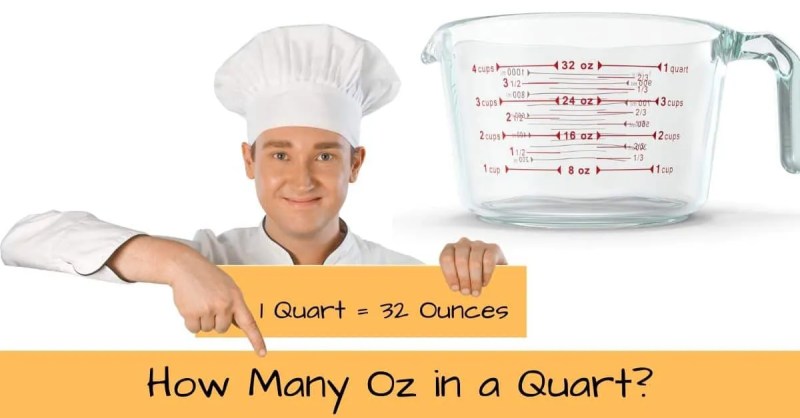
At its core, the quart’s dual nature stems from dimensional analysis. A liquid quart is defined by volume (2 pints = 1 quart), while a dry quart is defined by weight (a specific mass of a reference material, like wheat). This means that when you ask "how many ounces are in a quart", you’re not just asking about volume—you’re asking about the physical properties of what’s being measured. For liquids, the answer is straightforward: 1 quart = 32 fluid ounces, derived from the cubic-inch definition of the gallon. For dry goods, the answer varies because the quart’s weight depends on the density of the substance. A quart of sugar (weighing ~32 oz) isn’t the same as a quart of popcorn (weighing ~12 oz), even though both are technically "dry quarts."Table of Contents
- The Complete Overview of "How Many Oz Is a Quart"
- Historical Background and Evolution
- Core Mechanisms: How It Works
- Key Benefits and Crucial Impact
- Major Advantages
- Comparative Analysis
- Future Trends and Innovations
- Conclusion
- Comprehensive FAQs
- Q: Why does a liquid quart have fewer ounces than a dry quart?
- Q: Can I use a liquid quart measurement for dry ingredients?
- Q: Is a quart the same in the UK as in the US?
- Q: Why don’t more countries use the US quart system?
- Q: How do I convert quarts to liters?
- Q: Are there any industries where quarts are still critical?
- Q: Will the US ever switch to metric for quarts?
- Q: What’s the easiest way to remember "how many oz is a quart"?
The confusion arises because most people assume "quart" refers to volume alone, ignoring the context. In cooking, for example, a recipe might call for a "quart of milk" (liquid, 28 oz) but a "quart of berries" (dry, 32 oz). This ambiguity forces users to rely on hidden conventions: if a label says "quart," it’s usually liquid unless specified otherwise. Even in professional settings, like aviation fuel calculations or pharmaceutical dosing, the distinction matters. A pilot measuring fuel in quarts must use the liquid definition, while a farmer storing grain uses the dry definition. The system’s logic is sound, but its implementation is riddled with exceptions—making "how many oz is a quart" a question that demands context.
Key Benefits and Crucial Impact
Understanding "how many ounces are in a quart" isn’t just about avoiding measurement errors—it’s about operational efficiency. Industries like brewing, distilling, and baking rely on precise conversions to maintain consistency. A baker who misinterprets a dry quart as a liquid quart could end up with a cake that’s either too dense or too crumbly. Similarly, a chemist dosing a liquid medication must use the correct ounces-per-quart ratio to ensure potency. The impact extends to global trade: while most countries use metric, U.S. exports (like food or machinery) often require conversions, adding complexity to supply chains. Even in everyday life, knowing the difference can save money—imagine ordering a "quart" of ice cream only to realize it’s 28 oz instead of the 32 oz you expected.The dual-system approach also reflects adaptability. The U.S. measurement system was designed to accommodate both volume-based (liquids) and weight-based (dry goods) industries, a flexibility that metric systems lack. While metric simplifies conversions (e.g., 1 liter = 1,000 milliliters), it doesn’t account for the varying densities of different substances. In contrast, the quart’s duality allows for practical precision—whether you’re measuring water, wheat, or wine. This adaptability has kept customary units relevant, even as the world shifts toward metric. The trade-off? A steeper learning curve for those asking "how many oz is a quart" for the first time.
"Measurement is the first step that leads to control and, eventually, to mastery." — Lord Kelvin (1824–1907), physicist and proponent of precise standards.
Major Advantages
- Industry-Specific Precision: Dry quarts (32 oz) are optimized for granular or powdered goods, while liquid quarts (28 oz) align with fluid dynamics, reducing waste in manufacturing.
- Cultural Continuity: Legacy units like quarts persist in daily language (e.g., "quart of milk"), preserving tradition while coexisting with metric standards.
- Trade Compatibility: The U.S. system’s duality allows for seamless transitions between volume and weight, crucial in industries like agriculture and food processing.
- Error Reduction in Recipes: Clear distinctions prevent miscalculations in cooking, where ingredient ratios are critical (e.g., a "quart" of flour vs. a "quart" of broth).
- Legal and Regulatory Alignment: Many U.S. laws and industry standards (e.g., fuel, pharmaceuticals) are built around these units, ensuring compliance.
Comparative Analysis
| Measurement System | How Many Oz in a Quart? |
|---|---|
| US Liquid (Fluid) | 28 fluid ounces (exact: 29.5735295625 mL × 256 = 7,570.8237 mL) |
| US Dry | 32 dry ounces (varies by substance; based on bushel system) |
| Imperial (UK) | 33.8140226 fluid ounces (slightly larger than US liquid quart) |
| Metric (Liter-Based) | N/A (1 liter ≈ 33.814 US fluid oz; no direct "quart" equivalent) |
Future Trends and Innovations
The future of "how many oz is a quart" hinges on global standardization. While the U.S. has no immediate plans to abandon customary units, industries like aviation, science, and medicine are increasingly adopting metric exclusively. This shift is driven by international collaboration: NASA, for example, uses metric for all space missions, forcing U.S. engineers to convert between systems mid-project. Even in everyday life, younger generations are more fluent in metric, reducing the reliance on quarts and ounces for basic measurements. However, cultural resistance remains strong—surveys show that only 15% of Americans prefer metric for daily use, compared to 85% who default to customary units.Innovation may bridge the gap. Smart kitchen scales and apps now auto-convert between systems, making "how many ounces in a quart" less of a manual calculation and more of a background process. Additionally, industries like craft brewing and distilling are adopting hybrid systems, using metric for global trade while keeping quarts for local branding. The quart itself may evolve too: as technology advances, we might see digital quarts—standardized, context-aware units that adjust based on the substance being measured. Until then, the answer to "how many oz is a quart" will remain a study in how tradition and progress coexist.

Conclusion
The question "how many ounces are in a quart" is more than a simple conversion—it’s a window into the history, culture, and practicality of measurement. The dual answer (28 oz for liquids, 32 oz for dry goods) reflects a system designed for real-world utility, where one size doesn’t fit all. While the metric system offers simplicity, the U.S. retains its customary units because they’re deeply embedded in commerce, language, and daily life. For professionals, this means mastering context; for consumers, it means paying attention to labels. The next time you ask "how many oz is a quart," remember: the answer isn’t just about numbers—it’s about the legacy of how we measure the world.As industries continue to globalize, the quart’s relevance may wane, but its story endures as a reminder of how measurement systems are shaped by human need, not just mathematics. Whether you’re baking a cake, brewing beer, or shipping goods across borders, understanding these distinctions ensures accuracy—and that’s a skill that transcends trends.
Comprehensive FAQs
Q: Why does a liquid quart have fewer ounces than a dry quart?
A: The difference stems from how the units were defined. A liquid quart is based on the gallon’s volume (231 cubic inches), while a dry quart is tied to the bushel system, where weight varies by substance. Liquids are measured by volume, but dry goods account for density, leading to the higher ounce count.
Q: Can I use a liquid quart measurement for dry ingredients?
A: Technically, yes—but it’s inaccurate. A "quart" of flour by volume (liquid quart) would weigh less than a dry quart because flour is less dense than water. Always check whether a recipe specifies "dry quart" or "liquid quart" to avoid errors.
Q: Is a quart the same in the UK as in the US?
A: No. The Imperial quart (UK) is larger than the US liquid quart—33.814 oz vs. 28 oz. This discrepancy can cause issues in trade or travel, where measurements must be converted carefully.
Q: Why don’t more countries use the US quart system?
A: The US system’s duality (dry vs. liquid) and lack of metric alignment make it impractical for global standardization. Most countries adopted metric in the 19th–20th centuries for its simplicity and universality.
Q: How do I convert quarts to liters?
A: Use these conversions:
- US liquid quart = 0.946353 liters
- US dry quart ≈ 1.101221 liters (varies by substance)
Q: Are there any industries where quarts are still critical?
A: Yes. Industries like brewing, distilling, and baking rely on quarts for traditional recipes and equipment (e.g., keg sizes, mixing bowls). Even in science, some lab protocols use quarts for legacy reasons.
Q: Will the US ever switch to metric for quarts?
A: Unlikely in the near term. While metric is dominant in science and medicine, customary units persist in daily life due to cultural attachment. However, hybrid systems (e.g., metric labels with quart equivalents) are becoming more common.
Q: What’s the easiest way to remember "how many oz is a quart"?
A: Use this mnemonic:
- "Liquids are Light" – 28 oz (easier to remember as "less than 32").
- "Dry is Dense" – 32 oz (more ounces for solids).
Leave a Comment
Comments are moderated before appearing. The data you submit is processed according to the Privacy Policy of Bevvy.