The Smart Way to Answer: How Much Life Insurance Do I Need?
Life insurance isn’t just a policy—it’s a financial safety net designed to replace your income, cover debts, and secure your loved ones’ stability when you’re no longer there. Yet, determining how much life insurance do I need remains one of the most overlooked financial decisions, often left to vague estimates or outdated rules of thumb (like the "10x your salary" myth). The reality is far more nuanced: your coverage should align with your family’s specific liabilities, future goals, and even inflation risks. Without precise planning, you risk either leaving gaps in protection or paying premiums that drain resources unnecessarily.
The stakes are higher than most realize. A sudden loss without adequate coverage can force survivors into debt, disrupt education funds, or force them to sell assets at inopportune times. Conversely, over-insuring leaves you with high premiums that could have funded retirement or investments instead. The solution lies in a structured approach—one that balances immediate needs with long-term security, while accounting for variables like healthcare costs, estate taxes, and the evolving financial landscape.
Many assume how much life insurance do I need is a one-time calculation, but it’s a dynamic equation that should be revisited every 2–3 years or after major life events (marriage, children, home purchase, or career shifts). The key is moving beyond generic benchmarks to a personalized formula that integrates your debt structure, income replacement ratio, and the specific financial dependencies of your beneficiaries.

The Complete Overview of How Much Life Insurance Do I Need
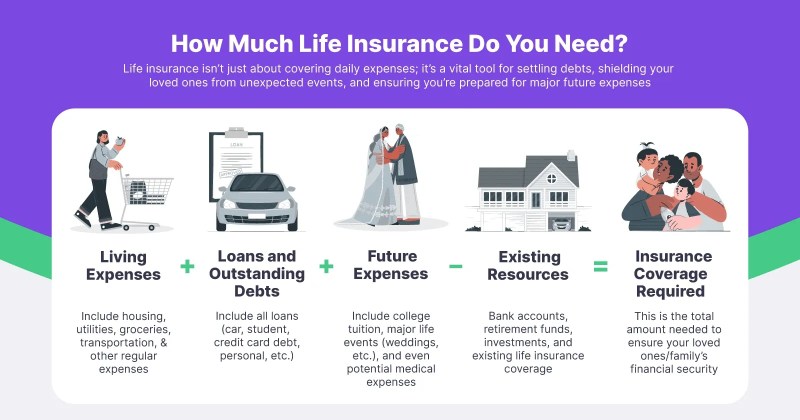
The question how much life insurance do I need isn’t just about replacing income—it’s about preserving your family’s lifestyle, paying off obligations, and funding future aspirations. Financial advisors often start with a "human life value" approach, which estimates the present value of your future earnings, but this ignores debts, taxes, and non-income contributions (e.g., childcare or homemaking). A more robust method combines the DIME formula (Debt, Income, Mortgage, Education) with inflation adjustments and liquidity buffers. For example, a 35-year-old with $80,000 in student loans, a $300,000 mortgage, and two children might need $2 million in coverage—not to mention the cost of a 20-year college fund for each child at $50,000/year (inflation-adjusted).The answer also depends on the type of policy you choose. Term life insurance offers temporary, affordable coverage tied to a specific period (e.g., 20 or 30 years), making it ideal for debt-heavy years. Whole life or universal policies, while pricier, build cash value and can fund legacy gifts or long-term care. The trade-off? Term insurance might cost $30/month for $500,000 coverage, while whole life could exceed $200/month for the same face value. The decision hinges on whether you prioritize flexibility or lifelong protection—and whether your beneficiaries need immediate liquidity or can rely on other assets.
Historical Background and Evolution
Life insurance traces its origins to ancient risk-pooling systems, like Roman burial clubs where members contributed to cover funeral costs. By the 18th century, European insurers formalized actuarial science, using mortality tables to price policies. The modern framework for how much life insurance do I need emerged in the early 20th century with the rise of income replacement models, particularly after World War I, when veterans’ families faced financial instability. The 1950s saw the popularization of the "70% income replacement" rule—a simplification that ignored inflation and rising costs. Today, algorithms and big data allow for hyper-personalized calculations, but many consumers still rely on outdated heuristics.The shift toward digital tools has democratized access to precise estimates. Online calculators now factor in variables like disability income riders, critical illness add-ons, and even cryptocurrency portfolios (yes, some insurers now assess digital assets). However, the human element remains critical. A 2022 LIMRA study found that 40% of policyholders underestimate their needs by 30% or more, often because they fail to account for non-financial dependencies (e.g., a stay-at-home parent’s unpaid labor). The evolution of how much life insurance do I need reflects broader societal changes—from nuclear families to blended households, and from defined-benefit pensions to gig-economy incomes.
Core Mechanisms: How It Works
At its core, life insurance operates on three pillars: risk assessment, premium calculation, and payout structure. Insurers evaluate your health, lifestyle, and occupation to determine risk tiers (e.g., non-smoker vs. smoker, high-risk profession). Premiums are then set based on your age, gender, and coverage amount, with younger applicants paying significantly less due to lower mortality risk. For instance, a 30-year-old non-smoker might pay $25/month for $1 million in 20-year term coverage, while a 45-year-old smoker could face $120/month for the same policy. The payout—whether a lump sum or structured payments—is triggered by your death (or, in some cases, terminal illness).Table of Contents
- The Complete Overview of How Much Life Insurance Do I Need
- Historical Background and Evolution
- Core Mechanisms: How It Works
- Key Benefits and Crucial Impact
- Major Advantages
- Comparative Analysis
- Future Trends and Innovations
- Conclusion
- Comprehensive FAQs
- Q: How do I calculate how much life insurance do I need?
- Q: Does my age affect how much life insurance I need?
- Q: Should I include my spouse’s income when calculating how much life insurance do I need?
- Q: Can I adjust my life insurance coverage later if my needs change?
- Q: What’s the difference between term and whole life when answering how much life insurance do I need?
- Q: Do I need separate policies for different financial goals (e.g., mortgage vs. education)?h3> A: Not necessarily—one large policy can cover multiple needs. However, if you have a high-risk hobby (e.g., skydiving), a separate policy might be cheaper. Alternatively, use a second-to-die policy for estate taxes if you’re married, which pays out only after both spouses pass. Q: How does inflation affect how much life insurance do I need?
- Q: Can I use life insurance to pay for my children’s college?
- Q: What if I have no dependents? Should I still get life insurance?
- Q: How do I choose between a $500K and $1M policy if I’m unsure how much life insurance do I need?
The mechanics behind how much life insurance do I need involve balancing actuarial science with personal finance. Policies like term life use a "level death benefit" structure, where the payout remains constant but premiums may increase with age (or convert to whole life). Whole life policies, conversely, accumulate cash value tax-deferred, allowing policyholders to borrow against the policy or surrender it for partial value. Understanding these mechanisms is crucial: a $1 million term policy might seem sufficient, but if your mortgage is $400,000 and your children’s college fund requires $200,000/year for 18 years, the math reveals a shortfall—especially after taxes and inflation erode the payout’s purchasing power.
Key Benefits and Crucial Impact
The primary benefit of addressing how much life insurance do I need is financial security for your dependents. Without it, survivors often face forced liquidation of assets, credit card debt, or reliance on social services. A 2023 study by the Insurance Information Institute found that 60% of Americans couldn’t cover a $1,000 emergency without borrowing, yet only 54% have any life insurance. The emotional toll is compounded by the practical: unpaid medical bills can lead to wage garnishment, and uninsured deaths may leave beneficiaries with unpaid loans or lost inheritances.Beyond immediate relief, life insurance serves as a strategic tool for wealth transfer. Policies can fund trusts to protect minors, cover estate taxes (which can exceed $1 million for high-net-worth individuals), or provide liquidity for business partners in a buy-sell agreement. The psychological impact is equally significant—knowing your family won’t face financial ruin after your death allows you to focus on living fully, rather than worrying about "what ifs."
"Life insurance isn’t about the money—it’s about the stories you leave behind. Your policy ensures those stories aren’t cut short by financial hardship." — David Bach, Financial Author & Life Insurance Expert
Major Advantages
- Income Replacement: Replaces 70–100% of your salary for 10–20 years, depending on your family’s needs. For example, a dual-income household where one partner earns $150,000/year may require $1 million in coverage to maintain lifestyle for 15 years.
- Debt Elimination: Covers mortgages, student loans, and credit card balances, preventing survivors from inheriting debt. A $500,000 mortgage with 5% interest could cost $3,000/month without insurance.
- Education Funding: Secures college or vocational training for children. At $25,000/year for four years, two kids would need $200,000—before inflation.
- Estate Planning: Provides liquidity to pay estate taxes or equalize inheritances among heirs. Without it, heirs may need to sell property to cover taxes.
- Business Continuity: Ensures partners or key employees can buy out your share, preventing forced sales or bankruptcy. A $2 million policy might cost $50/month for a small business owner.
Comparative Analysis
| Term Life Insurance | Whole Life Insurance |
|---|---|
|
|
Future Trends and Innovations
The life insurance industry is undergoing a digital transformation, with insurers leveraging AI to personalize how much life insurance do I need based on real-time data. Wearable devices now track health metrics to adjust premiums dynamically, while blockchain is being tested for fraud-proof claims processing. Another trend is "living benefits" riders, which allow policyholders to access funds early for critical illnesses or long-term care—effectively turning life insurance into a hybrid health and wealth tool.Emerging markets are also reshaping the landscape. In Asia, micro-insurance policies (as low as $1/month) are bridging gaps for low-income families, while in the U.S., insurtech startups offer instant approvals and customizable riders (e.g., pet care or travel accident coverage). The future may even see policies tied to cryptocurrency or NFT-based assets, though regulatory hurdles remain. One certainty: the question of how much life insurance do I need will become more interactive, with algorithms suggesting adjustments based on life changes—divorce, a new home, or even a career pivot.

Conclusion
Determining how much life insurance do I need isn’t a static question—it’s an ongoing dialogue between your financial reality and your family’s future. The key is to move beyond the "10x salary" shortcut and adopt a tailored approach that accounts for debts, education costs, inflation, and non-financial contributions. Start by calculating your "replacement ratio" (how much income your family needs to maintain their standard of living), then layer in specific liabilities like mortgages or student loans. Don’t forget to revisit this calculation every few years, especially after major life events.The right policy isn’t just about the number on the certificate—it’s about the peace of mind it provides. Whether you choose term for affordability or whole life for lifelong protection, the goal is the same: ensuring your legacy isn’t defined by financial strain. Begin with a clear understanding of your needs, compare options rigorously, and consult a fee-only advisor to avoid conflicts of interest. The time to ask how much life insurance do I need is now—not when it’s too late.
Comprehensive FAQs
Q: How do I calculate how much life insurance do I need?
A: Use the DIME formula (Debt + Income Replacement + Mortgage + Education) as a starting point. For example:
- Debt: $150,000 (student loans + mortgage)
- Income: 70% of $120,000 salary = $84,000/year × 15 years = $1.26M
- Mortgage: $300,000
- Education: $200,000 for two kids
Q: Does my age affect how much life insurance I need?
A: Yes—older applicants pay higher premiums, so younger individuals can secure lower-cost policies. However, your coverage amount should increase with responsibilities (e.g., buying a home or having children). A 30-year-old might need $1M, while a 45-year-old with a mortgage and college-age kids may require $2M–$3M.
Q: Should I include my spouse’s income when calculating how much life insurance do I need?
A: Only if your spouse’s income is critical to your family’s financial stability. For example, if one partner earns 80% of the household income, you’d prioritize replacing that salary. If incomes are balanced, focus on shared debts and future goals (e.g., retirement savings).
Q: Can I adjust my life insurance coverage later if my needs change?
A: Yes—most term policies allow increases (subject to underwriting) or conversions to whole life. Whole life policies can be adjusted upward with medical approval. Review your coverage annually, especially after major events like marriage, divorce, or inheritance.
Q: What’s the difference between term and whole life when answering how much life insurance do I need?
A: Term provides temporary, affordable coverage (ideal for debts or income replacement), while whole life offers lifelong protection with cash value (better for estate planning or permanent needs). If you need $1M for 20 years, term is cheaper. If you want $1M for life + cash value, whole life fits—but costs 5–10x more.
Q: Do I need separate policies for different financial goals (e.g., mortgage vs. education)?h3>
A: Not necessarily—one large policy can cover multiple needs. However, if you have a high-risk hobby (e.g., skydiving), a separate policy might be cheaper. Alternatively, use a second-to-die policy for estate taxes if you’re married, which pays out only after both spouses pass.
Q: How does inflation affect how much life insurance do I need?
A: A $1M policy today may only replace $700K in 20 years due to inflation. Use the 72-Month Rule: Multiply your annual income by 72 to account for 3% annual inflation. For a $100K salary, aim for $7.2M in coverage if you want it to last 15 years.
Q: Can I use life insurance to pay for my children’s college?
A: Yes—designate a portion of your policy (e.g., $100K) for education funds. Use a 529 Plan alongside the policy to maximize tax benefits. Avoid over-insuring for college; prioritize income replacement and debt clearance first.
Q: What if I have no dependents? Should I still get life insurance?
A: Yes—consider final expense insurance ($10K–$50K) to cover funeral costs ($7K–$12K average) or end-of-life medical bills. Even single individuals with aging parents or shared debts may need coverage. A small policy ensures you don’t leave financial burdens to loved ones.
Q: How do I choose between a $500K and $1M policy if I’m unsure how much life insurance do I need?
A: Start with $500K if your debts and income replacement needs are modest. Upgrade to $1M if you have:
- A mortgage over $300K
- Children with college costs
- High earning potential (replace 100% of income)
- Estate tax liabilities
Leave a Comment
Comments are moderated before appearing. The data you submit is processed according to the Privacy Policy of Bevvy.