How Functional Programming Redefines Modern Software Development
Functional programming isn’t just another programming trend—it’s a fundamental rethinking of how software behaves. Unlike object-oriented or imperative approaches, functional programming (FP) treats computation as the evaluation of mathematical functions, emphasizing immutability, pure functions, and declarative constructs. This paradigm forces developers to eliminate side effects, embrace higher-order functions, and design systems that are inherently more predictable. The result? Codebases that scale effortlessly, bugs that are easier to trace, and architectures that resist the chaos of concurrent operations.
Yet FP remains misunderstood. Many associate it with niche languages like Haskell or Lisp, overlooking its growing influence in mainstream ecosystems—JavaScript (via React and Redux), Python (with libraries like Pandas), and even C# (through LINQ). The shift isn’t about abandoning familiar tools; it’s about adopting a mindset where data transformations are first-class citizens, and state management becomes an afterthought rather than a battleground.
The irony is that FP’s principles—immutability, referential transparency, and composability—were pioneered decades ago, yet their practical applications are only now gaining traction. Why? Because modern systems demand resilience: distributed architectures, real-time data pipelines, and AI-driven workflows all thrive when side effects are minimized. Functional programming delivers that resilience by design.

The Complete Overview of Functional Programming
Functional programming is a programming paradigm that treats computation as the evaluation of expressions, avoiding mutable state and side effects. At its core, FP revolves around pure functions—mathematical constructs where the same input always yields the same output, with no reliance on external state. This purity simplifies reasoning about code, as functions become predictable and composable. Languages like Haskell, Clojure, and Scala embody these principles, but FP techniques are increasingly integrated into hybrid languages (e.g., JavaScript’s arrow functions, Python’s `map`/`filter`). The paradigm’s strength lies in its ability to abstract away complexity, making systems easier to test, debug, and scale.
The shift toward FP isn’t just theoretical; it’s a response to the growing pains of traditional paradigms. As applications grow in scale—think microservices, event-driven architectures, or data-intensive workflows—the overhead of managing mutable state becomes prohibitive. Functional programming mitigates this by encouraging developers to model data flows as immutable pipelines, reducing the risk of race conditions and unintended mutations. This isn’t about replacing OOP or imperative styles entirely but about adopting FP’s best practices where they provide the most value: concurrency, data processing, and system reliability.
Historical Background and Evolution
The roots of functional programming trace back to the 1930s with Alonzo Church’s lambda calculus, a formal system for expressing computation. By the 1950s, Lisp—created by John McCarthy—became the first language to implement these ideas, treating programs as symbolic expressions. The 1980s saw the rise of Haskell, named after logician Haskell Curry, which formalized lazy evaluation and type systems. Meanwhile, ML (Meta Language), developed at Carnegie Mellon, introduced pattern matching and strong typing, influencing later languages like F# and OCaml.
Table of Contents
- The Complete Overview of Functional Programming
- Historical Background and Evolution
- Core Mechanisms: How It Works
- Key Benefits and Crucial Impact
- Major Advantages
- Comparative Analysis
- Future Trends and Innovations
- Conclusion
- Comprehensive FAQs
- Q: Is functional programming only for academic languages like Haskell?
- Q: How does immutability improve performance?
- Q: Can functional programming handle side effects?
- Q: Is functional programming harder to learn?
- Q: What industries benefit most from functional programming?
- Q: How do I start using functional programming in my existing codebase?
The 21st century marked FP’s mainstream crossover. The explosion of JavaScript frameworks (React, Redux) popularized FP concepts like reducers and pure components, while data science tools (Apache Spark, Pandas) leveraged FP’s strengths in parallel processing. Even enterprise languages like Java and C# adopted FP features (e.g., streams, lambdas). Today, FP is no longer confined to academic circles; it’s a pragmatic choice for industries where correctness and scalability are non-negotiable—finance, aerospace, and large-scale web services.
Core Mechanisms: How It Works
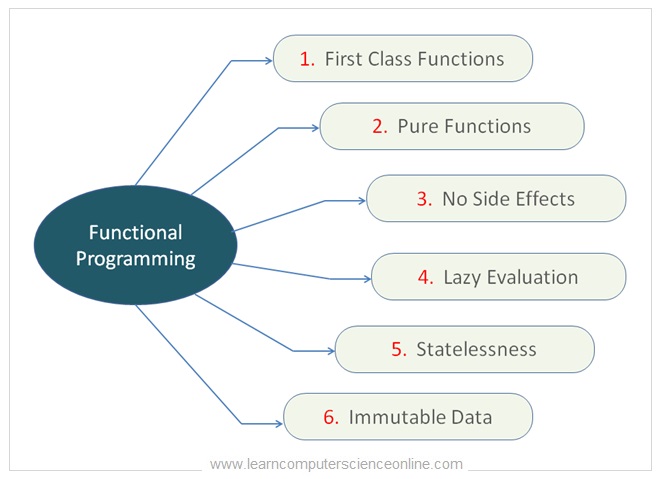
Functional programming operates on three pillars: immutability, pure functions, and higher-order functions. Immutability means data cannot be altered after creation; instead, new versions are generated. This eliminates hidden dependencies, making code easier to reason about. Pure functions, by definition, have no side effects and produce the same output for the same input, enabling safe concurrency and memoization. Higher-order functions (functions that take or return other functions) enable abstraction, allowing developers to compose complex behaviors from simple primitives.
The mechanics extend to concepts like recursion (preferred over loops), pattern matching (for data decomposition), and monads (for managing side effects in a pure context). For example, in Haskell, monads like `Maybe` or `Either` handle failure states without exceptions, while in JavaScript, the `Promise` monad manages asynchronous operations. These tools transform FP from a theoretical curiosity into a practical framework for building robust systems. The key insight? By constraining how functions interact, FP reduces the surface area for bugs, making large-scale software more maintainable.
Key Benefits and Crucial Impact
Functional programming’s impact is most visible in domains where reliability is critical. Financial systems, for instance, use FP to audit transactions by ensuring immutability and traceability. In distributed systems, FP’s emphasis on pure functions simplifies parallelism, as shared state—a common source of bugs—is minimized. Even in frontend development, FP’s declarative style (e.g., React’s virtual DOM) improves performance by reducing unnecessary re-renders. The paradigm’s benefits aren’t just technical; they’re economic. Teams adopting FP report fewer bugs in production, faster debugging cycles, and easier onboarding due to code’s self-documenting nature.
The shift toward FP also reflects broader industry trends. As cloud-native architectures demand stateless services and serverless functions, FP’s alignment with these models becomes apparent. Similarly, the rise of data pipelines (e.g., Apache Beam) leverages FP’s strengths in batch and stream processing. The message is clear: functional programming isn’t an alternative to mainstream paradigms but a complementary toolkit for solving problems where side effects and mutable state introduce complexity.
"Functional programming is about writing software that behaves like mathematics—deterministic, composable, and free from hidden dependencies. The payoff isn’t just cleaner code; it’s systems that scale without collapsing under their own weight."
— Richard Feldman, Creator of Elm
Major Advantages
- Predictability: Pure functions eliminate side effects, making behavior deterministic and easier to test. This is critical in concurrent or distributed environments where race conditions are common.
- Composability: Functions can be combined like Lego blocks, enabling modular design. Libraries like Ramda (JavaScript) or Lens (Haskell) formalize this, reducing boilerplate.
- Immutability: Immutable data structures prevent unexpected mutations, simplifying state management. Frameworks like Redux (React) enforce this principle at scale.
- Concurrency-Friendly: Without shared mutable state, FP systems avoid locks and threads, making parallelism safer. Erlang’s actor model, for example, relies on FP principles for fault tolerance.
- Testability: Pure functions are trivially unit-testable since they have no external dependencies. This reduces flakiness in test suites, a common pain point in OOP-heavy codebases.
Comparative Analysis
| Aspect | Functional Programming | Object-Oriented Programming |
|---|---|---|
| State Management | Immutable data; state changes via new data transformations. | Mutable objects; state changes via methods. |
| Side Effects | Minimized; handled via monads or pure wrappers. | Common; methods often modify external state. |
| Concurrency | Safer; no shared mutable state reduces race conditions. | Riskier; requires locks or synchronization. |
| Abstraction | Functions as first-class citizens; higher-order functions enable composition. | Classes and inheritance; abstraction via polymorphism. |
Future Trends and Innovations
The next decade of functional programming will likely focus on bridging the gap between theory and industry adoption. Hybrid approaches—where FP techniques are selectively applied—are already common (e.g., using FP in data layers while keeping OOP for UI). Emerging trends include FP’s role in quantum computing (where immutability and pure functions are natural fits) and its integration with AI/ML pipelines, where data transformations are inherently functional. Additionally, languages like Zig and Rust are experimenting with FP-inspired features (e.g., iterators, pattern matching) without full paradigm shifts.
Another frontier is FP’s impact on WebAssembly (WASM), where immutable data structures could optimize performance for high-frequency trading or real-time analytics. As edge computing grows, FP’s stateless nature aligns with serverless architectures, reducing cold-start latency. The challenge will be educating developers: FP isn’t about memorizing monads but about recognizing when to apply its principles to solve real-world problems. The future belongs to those who treat FP as a toolkit, not a dogma.

Conclusion
Functional programming isn’t a silver bullet, but it’s a powerful lens for tackling modern software challenges. Its emphasis on immutability, purity, and composition addresses the scalability and reliability issues plaguing large-scale systems. The paradigm’s growth reflects a broader industry realization: complexity isn’t just technical; it’s often a consequence of poor state management and side effects. By adopting FP’s principles—even in hybrid forms—developers can build systems that are easier to reason about, test, and scale.
The key takeaway? Functional programming isn’t about replacing existing paradigms but about augmenting them. Whether you’re processing streams in Python, managing state in JavaScript, or designing distributed systems in Go, FP offers a set of tools to write code that’s more robust, maintainable, and aligned with the demands of today’s architectures. The question isn’t if FP will dominate but how it will continue to evolve alongside the problems it was designed to solve.
Comprehensive FAQs
Q: Is functional programming only for academic languages like Haskell?
A: No. While Haskell and Lisp are pure FP languages, mainstream languages like JavaScript (with Redux), Python (with functional libraries), and Scala (a hybrid OOP/FP language) integrate FP principles. Even C# and Java support FP via lambdas and streams. The paradigm’s tools are increasingly accessible without adopting a full FP language.
Q: How does immutability improve performance?
A: Immutability enables optimizations like memoization (caching function results) and structural sharing (reusing unchanged parts of data). In concurrent systems, it eliminates the need for locks, reducing overhead. Frameworks like Redux leverage immutability to trigger updates efficiently, while languages like Clojure use persistent data structures for O(1) access time.
Q: Can functional programming handle side effects?
A: Yes, but indirectly. FP avoids side effects in pure functions and uses monads (e.g., `IO` in Haskell, `Promise` in JavaScript) to encapsulate them. This allows side effects to exist without polluting the core logic. For example, file I/O in Haskell is handled via the `IO` monad, keeping the rest of the program pure.
Q: Is functional programming harder to learn?
A: It depends on your background. Developers familiar with OOP may struggle with concepts like monads or lazy evaluation, but the learning curve is manageable with incremental adoption. Many start with FP in JavaScript (e.g., using `map`/`filter`) before exploring pure FP languages. The challenge isn’t the math—it’s unlearning habits from mutable-state programming.
Q: What industries benefit most from functional programming?
A: Industries with high stakes for correctness and scalability see the most value. Finance (e.g., trading systems), aerospace (e.g., flight software), and data engineering (e.g., ETL pipelines) rely on FP for reliability. Even tech giants like Facebook (with Haskell for infrastructure) and Netflix (using FP in data workflows) adopt FP where it solves critical problems.
Q: How do I start using functional programming in my existing codebase?
A: Begin by identifying "hotspots" where mutable state causes bugs (e.g., shared variables in concurrent code). Replace mutable operations with immutable data structures (e.g., use `map` instead of loops, or `reduce` instead of accumulators). Gradually introduce pure functions and higher-order functions where they simplify logic. Tools like Ramda (JS) or Pyrsistent (Python) can help without requiring a full paradigm shift.
Leave a Comment
Comments are moderated before appearing. The data you submit is processed according to the Privacy Policy of Bevvy.