Unlocking Power in *Command 5e*: The Definitive Breakdown of D&D’s Game-Changing Rulebook
The command system in Dungeons & Dragons 5th Edition isn’t just another mechanic—it’s a paradigm shift in how players and Dungeon Masters (DMs) interact with authority, hierarchy, and tactical control. At its core, command 5e redefines leadership on the battlefield, blending spellcasting precision with narrative weight. Whether you’re a warlord barking orders at a regiment of soldiers or a rogue subtly manipulating a mob of thugs, the system transforms abstract social dynamics into measurable, in-game power. The rules don’t just describe command; they enforce it, creating moments where a single word can alter the course of a battle or a heist.
What separates command 5e from earlier editions is its granularity. No longer is "command" a vague modifier—it’s a structured, verb-driven interaction with clear parameters. Players must choose their words carefully, as the wrong phrasing can render even the most potent command spell useless. This precision forces DMs to design encounters where language itself becomes a weapon, and players to think like tacticians rather than just spellcasters. The system’s depth lies in its duality: it’s both a combat tool and a storytelling device, rewarding players who treat command as more than a button to press.
The evolution of command in D&D reflects broader trends in tabletop gaming—shifting from broad, narrative-driven authority to mechanics that demand player agency. Earlier editions treated command as a binary (success/failure), but 5e introduces layers: the Command spell’s verb requirements, the Dominate Person spell’s psychological nuances, and even the Suggestion spell’s subtle persuasive tactics. These aren’t just rules; they’re challenges to creativity, forcing players to ask: What exactly am I commanding, and how? The answer often determines victory or defeat.

The Complete Overview of Command 5e: Rules, Strategy, and Mastery
Command 5e is the umbrella term for a suite of rules governing how characters exert authority over others—whether through magic, charisma, or sheer intimidation. At its heart, the system is built on two pillars: spell-based commands (like the Command spell) and social commands (using skills like Persuasion or Intimidation). The former relies on strict linguistic precision, while the latter thrives on roleplaying nuance. Together, they create a framework where leadership isn’t just about strength or magic, but about how you wield influence. For DMs, this means designing encounters where command isn’t just a tool for the party’s spellcaster but a dynamic element that can be exploited—or resisted—by NPCs.The system’s flexibility is its greatest strength. A paladin might use Command to rally a village’s militia, while a tiefling warlock could Dominate a rival gang’s enforcer mid-fight. The rules even account for cultural and contextual factors: a command given in a language the target doesn’t understand fails, and a Suggestion might backfire if the target perceives it as a threat. This attention to detail elevates command 5e from a simple combat mechanic to a layer of the game’s immersive worldbuilding. Players who engage with the system thoughtfully can turn a simple spell into a pivotal moment—whether it’s a king’s decree that spares a city or a thief’s whispered order that turns a chase into a massacre.
Historical Background and Evolution
The concept of command in D&D traces back to the game’s earliest iterations, where spells like Charm Person (1974) laid the groundwork for mind-influencing magic. However, 5e refined the idea by stripping away ambiguity and introducing structured, verb-based requirements. Earlier editions treated command as a broad effect—success hinged on the DM’s whim—but 5e codified it, demanding players specify exactly what they’re commanding. This shift mirrors broader trends in D&D toward player agency and tactical depth. The Command spell, introduced in Xanathar’s Guide to Everything (2017), was a direct response to player feedback: they wanted command to be more than a "do what I say" button; they wanted it to be a tool.The evolution didn’t stop there. Command 5e now includes nuances like command verbs (e.g., "attack," "drop," "flee") and restrictions (e.g., no commands that require fine motor skills or self-harm). This level of detail ensures that command isn’t just a combat shortcut but a strategic choice. For example, commanding a target to "drop their weapon" might disarm them, but commanding them to "attack an ally" could trigger a loyalty check or even a backlash if the target resists. The system’s historical arc reflects D&D’s growing maturity—from a game of fantasy adventure to one where every word and action carries weight.
Core Mechanics: How Command 5e Works
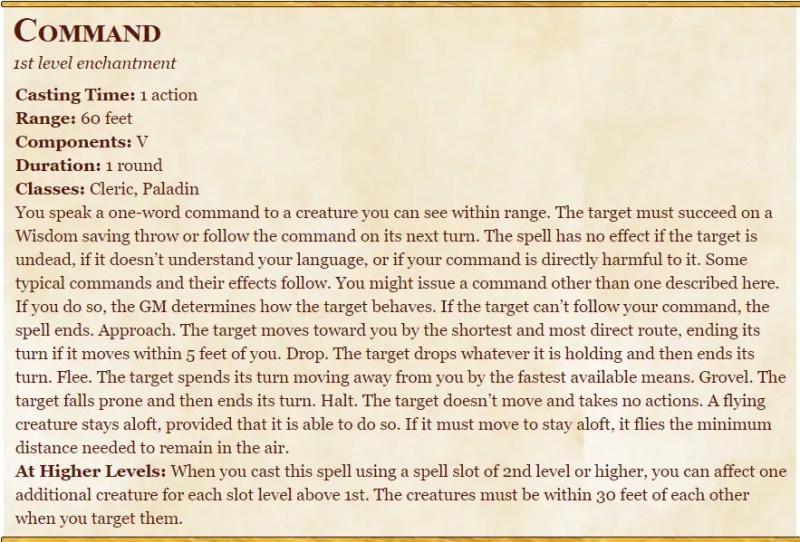
At its foundation, command 5e operates on three core principles: verb specificity, target compliance, and contextual resistance. The Command spell (and its variants) requires the caster to speak a single word or short phrase that the target must obey as best they can. The catch? The verb must be actionable—no abstract commands like "be happy" or "remember your childhood." Instead, players must choose verbs tied to physical or immediate actions: "kneel," "scream," "hand over your coin purse." This precision ensures that command isn’t a free pass for arbitrary control but a tactical tool with clear limits.Table of Contents
- The Complete Overview of Command 5e : Rules, Strategy, and Mastery
- Historical Background and Evolution
- Core Mechanics: How Command 5e Works
- Key Benefits and Crucial Impact
- Major Advantages
- Comparative Analysis
- Future Trends and Innovations
- Conclusion
- Comprehensive FAQs
- Q: Can a target resist a Command spell if they don’t understand the language?
- Q: Does commanding a target to "attack an ally" trigger a loyalty check for that ally?
- Q: Are there any Command verbs that are universally effective, regardless of context?
- Q: How does Dominate Person differ from Command in terms of duration and control?
- Q: Can a Command spell be used to manipulate a creature that’s already under a Charm effect?
- Q: Are there any racial or class restrictions on using Command spells?
- Q: What happens if a Command spell’s target is immune to being charmed?
- Q: Can a Command spell be used to force a target to cast a spell?
- Q: How do environmental factors (e.g., loud noises, distractions) affect Command spells?
- Q: Are there any Command spell variants or homebrew options for more nuanced control?
Compliance isn’t guaranteed. The target must make a Wisdom saving throw to resist, with modifiers based on the caster’s Charisma modifier and the spell’s power level. Even if they fail, the command isn’t absolute—targets might obey partially (e.g., dropping a weapon but not sheathing it) or delay the action (e.g., waiting until the next turn to comply). This layer of unpredictability forces players to weigh risk versus reward. For instance, commanding a foe to "drop their sword" might seem safe, but if they’re holding it aloft to cast a spell, the delay could be catastrophic. The system’s design ensures that command is never a guaranteed win—just a calculated gamble.
Key Benefits and Crucial Impact
Command 5e transforms passive spellcasting into an active, dynamic part of gameplay. Where other spells deal damage or heal wounds, command reshapes the battlefield by altering enemy behavior, creating openings, or even turning allies into temporary assets. For a party’s spellcaster, this means no longer relying solely on brute-force magic—command becomes a tool for control, deception, and psychological warfare. The impact extends beyond combat: a well-timed Suggestion can sway a noble’s vote, a Dominate Person spell can turn a guard into an unwitting ally, and a Command verb can defuse a tense negotiation. The system’s versatility makes it indispensable for DMs crafting high-stakes scenarios where words carry as much weight as swords.The psychological depth of command 5e is often overlooked. A target forced to obey a command might feel humiliated, resentful, or even traumatized—effects that can linger long after the spell’s duration ends. This adds a layer of narrative consequence that rewards players who think beyond the immediate tactical benefit. For example, commanding a prisoner to "apologize to the party" might secure information, but it could also sow distrust among the party’s allies. The system encourages players to consider the ripple effects of their actions, making command not just a combat tool but a storytelling one.
> "A well-placed command isn’t just an order—it’s a story." > — Jeremy Crawford, Lead Designer, Dungeons & Dragons 5e
Major Advantages
- Tactical Flexibility: Command 5e allows spellcasters to manipulate the battlefield in ways damage spells can’t. For example, commanding enemies to "flee" can turn a losing battle into a rout, while commanding allies to "cover you" can create strategic openings.
- Social and Political Leverage: Outside combat, command verbs can be used in roleplaying scenarios—persuading a merchant to lower prices, convincing a guard to ignore a crime, or even manipulating a rival faction’s leader into making a foolish decision.
- Narrative Depth: The system forces players to engage with the why behind their actions. Why command a target to "drop their weapon"? To disarm them, to create an opening, or to humiliate them? The answer shapes the story.
- Counterplay and Resistance: Unlike many spells, command has built-in resistance mechanics (saving throws, partial compliance). This makes it a high-risk, high-reward tool that keeps players on their toes.
- Scalability: From low-level spells like Command to high-level effects like Dominate Monster, the system grows with the party’s power, offering new strategic possibilities at every tier.
Comparative Analysis
| Feature | Command 5e | Earlier Editions (e.g., 3.5e, Pathfinder) |
|---|---|---|
| Verb Requirements | Strict, actionable verbs only (e.g., "attack," "drop"). | Broad commands (e.g., "do something harmful"). |
| Saving Throw Mechanics | Wisdom-based, with modifiers for Charisma and spell power. | Varies by spell; often Intelligence or Will saves. |
| Partial Compliance | Targets obey as best they can, with potential delays or loopholes. | Usually binary (success/failure). |
| Narrative Integration | Designed for social and combat scenarios; encourages roleplay. | Primarily combat-focused; less emphasis on narrative consequences. |
Future Trends and Innovations
The command 5e system is likely to evolve in future supplements, with a focus on expanding verb libraries (e.g., adding cultural or profession-specific commands) and deepening psychological consequences. We may see new spells that interact with command, such as a Counter-Command effect or a Command Echo that lingers after the spell’s duration. Additionally, D&D’s trend toward player-driven storytelling suggests that command could become even more narrative-focused, with rules for long-term manipulation (e.g., a Dominate Person spell leaving lasting trauma that affects future interactions).Another potential innovation is hybrid command spells—effects that combine command with other mechanics, such as a Command + Illusion combo that makes a target believe they’re obeying a higher authority. As D&D continues to emphasize player agency, we’ll likely see command become more about negotiation and persuasion than outright control. The future of command 5e may lie in making it a two-way street, where both the caster and the target have meaningful choices in how the command plays out.

Conclusion
Command 5e is more than a set of rules—it’s a philosophy of leadership, manipulation, and storytelling. Its precision demands that players think critically about language, context, and consequence, while its flexibility allows it to fit seamlessly into any campaign. For Dungeon Masters, it’s a tool for crafting encounters where words are weapons, and for players, it’s a chance to wield influence in ways that go beyond brute force. The system’s strength lies in its balance: it’s powerful enough to turn the tide of battle but limited enough to feel fair and engaging.As D&D continues to grow, command 5e will remain a cornerstone of tactical and narrative depth. Whether you’re a DM designing a heist where a single Command spell determines success or failure, or a player using Dominate Person to infiltrate a noble’s court, the system rewards creativity and strategy. In a game where imagination is the only limit, command 5e ensures that even the most mundane words can become the most potent tools of all.
Comprehensive FAQs
Q: Can a target resist a Command spell if they don’t understand the language?
A: Yes. The Command spell specifies that the target must understand the language used. If they don’t, they automatically succeed on their Wisdom saving throw, as they can’t comprehend the order.
Q: Does commanding a target to "attack an ally" trigger a loyalty check for that ally?
A: It depends on the ally’s alignment and bond with the original target. While the Command spell itself only affects the primary target, the ally might perceive the order as a betrayal, leading to roleplaying consequences (e.g., the ally attacking the caster instead). DMs should adjudicate based on the scenario.
Q: Are there any Command verbs that are universally effective, regardless of context?
A: No. The Command spell’s rules state that the verb must be "actionable" and not require fine motor skills or self-harm. Even then, the DM can rule that certain verbs (e.g., "sacrifice yourself") are invalid in specific contexts. There’s no "one-size-fits-all" command.
Q: How does Dominate Person differ from Command in terms of duration and control?
A: Dominate Person lasts 1 hour (or until the target takes damage) and grants the caster partial control over the target’s actions, as if they were charmed. Command, by contrast, is a 1-minute effect with a single, immediate action. Dominate Person is far more intrusive but also riskier, as the target can still act against the caster’s interests if given the chance.
Q: Can a Command spell be used to manipulate a creature that’s already under a Charm effect?
A: Yes, but the target must still make a Wisdom saving throw to resist the Command. However, the DM may rule that the Charm effect makes the target more susceptible to further manipulation, potentially giving the caster advantage on the save. This creates a powerful combo for controlling multiple targets.
Q: Are there any racial or class restrictions on using Command spells?
A: No, but certain classes and races have features that enhance their effectiveness. For example, a War Caster (feat) might gain advantage on saving throws against Command resistance, while a Charismatic race (e.g., tiefling, elf) could have a natural bonus to Persuasion/Intimidation checks related to command-like social interactions.
Q: What happens if a Command spell’s target is immune to being charmed?
A: The target automatically succeeds on their Wisdom saving throw, as immunity to charm effects extends to Command. However, the DM might allow a legendary resistance rule (if applicable) or rule that the target is unaffected but not necessarily resistant.
Q: Can a Command spell be used to force a target to cast a spell?
A: No. The Command spell’s rules explicitly prohibit commands that require fine motor skills (like casting a spell) or self-harm. A target could be commanded to "hand over your spellbook," but not to "cast Fireball at your ally."
Q: How do environmental factors (e.g., loud noises, distractions) affect Command spells?
A: The DM should rule on a case-by-case basis. A loud battle might make it harder for the target to hear the command (granting advantage on the save), while a quiet, intimate setting could make the command more effective. The key is to ensure the command feels immersive within the scene.
Q: Are there any Command spell variants or homebrew options for more nuanced control?
A: While 5e doesn’t include official variants, many DMs and players create homebrew Command spells with expanded verbs (e.g., "repeat my last words," "write a letter") or modified durations. Some supplements (like Tasha’s Cauldron of Everything) introduce new charisma-based features that could synergize with Command mechanics.
Leave a Comment
Comments are moderated before appearing. The data you submit is processed according to the Privacy Policy of Bevvy.