How the Equivocation Fallacy Manipulates Logic—and How to Spot It
The equivocation fallacy thrives in the gray areas between precision and ambiguity. At its core, it exploits the fluidity of language—where a single word or phrase carries multiple meanings, and an arguer slips between them without acknowledgment. This isn’t just a semantic quirk; it’s a deliberate tactic to mislead, often employed in political speeches, legal arguments, and even casual conversations where clarity dissolves into smoke. The danger lies in its subtlety: unlike outright lies, equivocation relies on the listener’s trust in shared understanding, making it harder to pinpoint.
Consider a politician who claims, "We must protect our freedoms"—then later argues for surveillance laws under the same banner. The word "freedoms" has shifted from personal liberties to national security, yet the audience may not notice the pivot. This isn’t accidental; it’s a calculated move to frame opposing views as illogical while masking a contradiction. The equivocation fallacy doesn’t require deception—just a failure to define terms rigorously. That’s why it’s so pervasive: it doesn’t demand creativity, only opportunism.
The fallacy’s power lies in its adaptability. It can appear in academic debates, where scholars redefine technical terms mid-argument, or in marketing, where slogans like "natural" or "premium" morph from one context to another. Even in personal conflicts, it surfaces when someone insists, "You never listen to me!"—only to later deny the same accusation. The pattern is always the same: a word or phrase is used in two incompatible ways, creating an illusion of consistency where there is none.
The Complete Overview of the Equivocation Fallacy
The equivocation fallacy is a type of informal logical fallacy where a term is used ambiguously—switching between different senses of the word within the same argument. Unlike other fallacies that rely on emotional appeals or false premises, this one exploits the inherent flexibility of language. A single word can mean vastly different things depending on context: "bank" as a financial institution or a river’s edge, "light" as weightless or luminous. When an arguer leverages this ambiguity intentionally, they create a false equivalence, making their conclusion seem valid when it’s not.What makes the equivocation fallacy particularly insidious is its reliance on the listener’s goodwill. Most people assume others are using language accurately unless proven otherwise. This cognitive bias—known as the principle of charity—works in the arguer’s favor. They don’t need to outright lie; they simply need to ensure the audience doesn’t catch the shift in meaning. For example, a company might advertise a product as "doctor-recommended" while omitting that the recommendation came from a single physician paid for the endorsement. The word "recommended" equivocates between professional consensus and a single, biased opinion.
Historical Background and Evolution
The concept of equivocation has roots in ancient rhetoric, where philosophers like Aristotle and later medieval logicians such as William of Ockham grappled with the boundaries of linguistic precision. Ockham, in particular, warned against "fallacies of ambiguity," arguing that unclear terms could undermine entire arguments. His razor—"entities should not be multiplied beyond necessity"—extended to language, urging speakers to define terms explicitly. Yet, the equivocation fallacy persisted because ambiguity is a natural feature of human communication, not just a flaw.By the Enlightenment, thinkers like John Locke and Immanuel Kant formalized the idea that language must align with reality to avoid deception. Kant’s Critique of Pure Reason emphasized the need for "determinate concepts" in logical discourse, directly countering the equivocation fallacy’s reliance on shifting definitions. However, the fallacy didn’t disappear—it evolved. In the 20th century, as mass media and political rhetoric expanded, equivocation became a tool of persuasion rather than mere oversight. Advertisers, politicians, and even scientists occasionally exploited it, knowing that audiences would fill in gaps with their own interpretations.
Core Mechanisms: How It Works
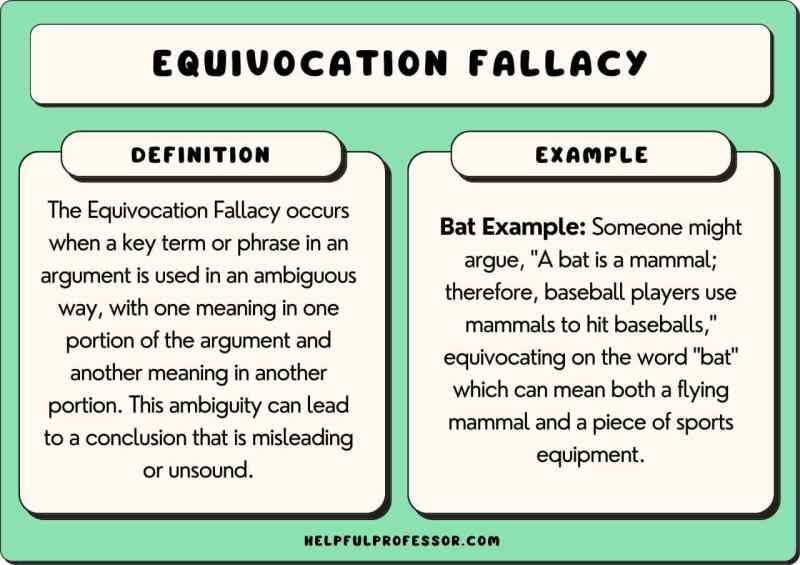
The equivocation fallacy operates on two primary levels: lexical ambiguity (a word with multiple meanings) and contextual ambiguity (a term’s meaning changes based on how it’s used). Lexical ambiguity is straightforward—think of "bat" as a flying mammal or a sports implement. Contextual ambiguity is more subtle: the same word might mean one thing in a formal setting and another in casual speech. For instance, "I’m not a racist, but..." often precedes a racially charged statement, where "racist" shifts from a fixed identity to a situational judgment.Table of Contents
- The Complete Overview of the Equivocation Fallacy
- Historical Background and Evolution
- Core Mechanisms: How It Works
- Key Benefits and Crucial Impact
- Major Advantages
- Comparative Analysis
- Future Trends and Innovations
- Conclusion
- Comprehensive FAQs
- Q: How can I tell if someone is using the equivocation fallacy in an argument?
- Q: Is the equivocation fallacy always intentional?
- Q: Can equivocation be used defensively in debates?
- Q: Are there industries where equivocation is particularly common?
- Q: What’s the best way to counter the equivocation fallacy?
- Q: Can AI or chatbots commit the equivocation fallacy?
- Q: Are there cultural differences in how equivocation is perceived?
- Q: Can equivocation be used creatively in writing or art?
The mechanism relies on anaphoric reference—the assumption that a later use of a word refers back to its first instance. If an arguer defines "freedom" narrowly in one clause but broadly in another, the audience may not detect the inconsistency. This is why equivocation often appears in syllogistic arguments, where the major premise sets a definition that the minor premise undermines. For example:
1. Major Premise: "All criminals are bad people." (Here, "bad" might mean morally corrupt.)
2. Minor Premise: "Tax evaders are criminals." (Now, "bad" could mean legally punishable.)
3. Conclusion: "Therefore, tax evaders are bad people." (The shift in "bad" goes unnoticed.)
The arguer hasn’t lied—they’ve simply allowed the term to drift, leaving the audience to reconcile the inconsistency themselves.
Key Benefits and Crucial Impact
The equivocation fallacy isn’t inherently malicious, but its strategic use can have profound consequences. In legal settings, it can obscure the truth by redefining terms mid-trial—for example, arguing that "reasonable doubt" in one case means "lack of absolute certainty" while in another, it implies "minor uncertainty." In business, companies use it to rebrand failures as successes: "We pivoted our strategy" might mask a product flop by redefining "pivot" from a setback to a calculated move.Politicians frequently deploy it to avoid accountability. A leader might claim, "I support law enforcement" while simultaneously advocating for policies that critics argue undermine police trust. The word "support" equivocates between active endorsement and passive tolerance. Even in academia, scholars sometimes redefine terms to align with their conclusions, creating a false sense of objectivity. The fallacy’s impact is amplified when it goes unchallenged, allowing misinformation to spread under the guise of logical argument.
"The great enemy of clear language is insincerity. When there is a gap between one’s real and one’s declared aims, one turns, as it were, instinctively to long words and exhausted idioms, like a cuttlefish squirting out ink." — George Orwell, Politics and the English LanguageThe quote captures the essence of the equivocation fallacy: language as a smokescreen. Orwell’s warning about "long words and exhausted idioms" describes how equivocation obscures meaning, not through complexity, but through deliberate vagueness.
Major Advantages
While the equivocation fallacy is often criticized, it offers tactical advantages in specific contexts:- Persuasive Flexibility: By shifting definitions, an arguer can make opposing views seem inconsistent with themselves, even if the original terms were used differently.
- Avoiding Direct Contradiction: Instead of admitting a flaw in an argument, the equivocator can redefine a term to make the contradiction appear resolved.
- Emotional Manipulation: Ambiguous language can trigger emotional responses (e.g., "family values" vs. "traditional morality") without requiring a clear, defensible position.
- Rapid Adaptation: In dynamic debates, equivocation allows an arguer to pivot without losing momentum, as the audience struggles to track shifting definitions.
- Plausible Deniability: If challenged, the equivocator can claim they were using terms in their "ordinary" sense, making it harder to prove deception.

Comparative Analysis
The equivocation fallacy shares similarities with other logical fallacies but differs in critical ways. Below is a comparison with closely related fallacies:| Fallacy | Key Difference |
|---|---|
| Equivocation Fallacy | A single term shifts meaning within the same argument, creating a false logical link. |
| Amphiboly | Ambiguity arises from grammatical structure (e.g., "The police shot the thief with a gun" could imply the thief had a gun or the police did). |
| Straw Man | The arguer misrepresents an opponent’s position by redefining their terms, rather than shifting meanings internally. |
| No True Scotsman | A moving goalpost where definitions are arbitrarily changed to exclude counterexamples (e.g., "No true environmentalist would support this law" after every objection is dismissed). |
Future Trends and Innovations
As language becomes increasingly digital, the equivocation fallacy is evolving alongside it. Algorithm-driven content—such as AI-generated summaries or social media bots—may inadvertently (or intentionally) propagate equivocation by repurposing terms across contexts without human oversight. For example, a news aggregator might describe a policy shift as "progressive" in one headline and "regressive" in another, using the same term to frame opposing viewpoints.Meanwhile, legal and ethical frameworks are beginning to address equivocation in AI communication. Courts are increasingly scrutinizing how language models interpret and redefine terms, particularly in high-stakes areas like healthcare or finance. Future innovations in natural language processing (NLP) could include tools that flag equivocation in real time, though this raises privacy concerns about monitoring discourse.
Politically, the fallacy may become even more entrenched as polarized audiences interpret the same words through opposing lenses. Terms like "democracy," "justice," or "safety" will likely see heightened equivocation as each side redefines them to fit their worldview. The challenge for critical thinkers will be developing dynamic definition-tracking systems—whether through education or technology—to counteract this trend.

Conclusion
The equivocation fallacy is more than a rhetorical trick; it’s a reflection of how language itself can be both a tool and a trap. Its persistence across centuries—from medieval debates to modern political rhetoric—underscores a fundamental truth: words are not neutral. They carry weight, and those who wield them ambiguously can reshape entire arguments without firing a shot.The antidote lies in rigorous definition. Before engaging in any debate, ask: What does this term mean here? Demand clarity not as an attack, but as a necessity for honest discourse. The equivocation fallacy thrives in silence; exposing it requires nothing more than the courage to ask, "Which meaning are you using—and why?" In an era where information is weaponized, that question may be the most powerful tool of all.
Comprehensive FAQs
Q: How can I tell if someone is using the equivocation fallacy in an argument?
A: Look for words or phrases that seem to change meaning without explanation. If a term is used in two incompatible ways—such as "freedom" shifting from personal liberty to security—challenge the arguer to define it consistently. Ask for examples or contexts where the term applies differently. If they can’t provide a clear, unified definition, equivocation is likely at play.
Q: Is the equivocation fallacy always intentional?
A: Not necessarily. Sometimes, it’s an unconscious oversight—especially in complex arguments where terms have multiple layers of meaning. However, in high-stakes contexts like politics or legal debates, equivocation is often deliberate. The key difference is whether the arguer recognizes and exploits the ambiguity or simply fails to notice it.
Q: Can equivocation be used defensively in debates?
A: Defensively, equivocation can be risky because it often backfires if the audience catches the inconsistency. However, in some cases, redefining terms can clarify ambiguity—for example, if two parties are using "sustainable" in conflicting ways. The ethical line is crossed when the redefinition is used to mislead rather than resolve confusion. Always ensure your redefinition serves the goal of clarity, not deception.
Q: Are there industries where equivocation is particularly common?
A: Yes. Politics and marketing are prime examples, where terms like "reform," "innovation," or "value" are frequently redefined to fit a narrative. Legal arguments also rely on equivocation, particularly in cases where semantic precision is critical. Even academia sees it when scholars stretch definitions to fit their theories. The more a term is open to interpretation, the higher the risk of equivocation.
Q: What’s the best way to counter the equivocation fallacy?
A: Explicit definition is the most effective strategy. When you encounter a potentially equivocal term, ask for a precise definition and demand consistency. For example:
- "When you say ‘X,’ do you mean [Definition A] or [Definition B]?"
- "Can you provide an example where ‘X’ applies in both senses?"
- "If ‘X’ means [Definition A] here, how does it also mean [Definition B] in your conclusion?"
Q: Can AI or chatbots commit the equivocation fallacy?
A: Yes, though unintentionally. AI models trained on vast datasets may repurpose terms across contexts without recognizing inconsistencies. For instance, a chatbot might describe a policy as "ethical" in one response and "controversial" in another, using the same term to frame opposing viewpoints. While not deliberate, this reflects the broader challenge of ensuring semantic consistency in machine-generated content. Future AI ethics guidelines may need to address this as a form of algorithmic ambiguity.
Q: Are there cultural differences in how equivocation is perceived?
A: Absolutely. In high-context cultures (e.g., Japan, many Middle Eastern societies), indirect communication is often valued, and equivocation may be seen as a nuanced way to avoid conflict. In low-context cultures (e.g., Germany, Nordic countries), precision is prioritized, and equivocation is more likely to be viewed as deceptive. This cultural divide explains why the fallacy is more prevalent in some political or business environments than others.
Q: Can equivocation be used creatively in writing or art?
A: Yes, but ethically. Poetry, literature, and visual art often rely on equivocation to create layers of meaning. For example, a poem might use "dark" to evoke both night and melancholy, enriching the reader’s interpretation. The difference lies in intent: in art, the ambiguity is usually aesthetic; in argumentation, it’s often manipulative. The key is transparency—if the audience understands the dual meaning is intentional, it’s not a fallacy.
Leave a Comment
Comments are moderated before appearing. The data you submit is processed according to the Privacy Policy of Bevvy.