The Exact Number of Chromosomes in Daughter Cells After Mitosis Explained
The human body performs an astonishing feat every second—trillions of cells divide, replicate, and specialize without error. At the heart of this precision lies mitosis, the cellular process that ensures every daughter cell inherits the exact genetic blueprint of its parent. Yet, despite its ubiquity, the question of how many chromosomes are in each daughter cell at the end of mitosis remains a critical threshold for understanding heredity, growth, and repair. The answer isn’t just a number; it’s the foundation of genetic stability across all multicellular organisms.
This consistency isn’t accidental. From the moment DNA replicates in the S phase to the final cytokinesis that splits the cytoplasm, mitosis enforces a strict rule: each daughter cell must receive a diploid complement of chromosomes identical to the original cell. Deviations—whether through nondisjunction or aneuploidy—can lead to diseases like Down syndrome or cancer. The process is so finely tuned that even a single misplaced chromosome can disrupt an organism’s development. Yet, for all its precision, mitosis is often oversimplified in basic biology courses, leaving gaps in public understanding of why this number matters.
The implications stretch beyond textbooks. In medicine, knowing how many chromosomes are in each daughter cell at the end of mitosis helps diagnose genetic disorders. In biotechnology, it informs stem cell research and cloning. Even in evolutionary biology, the fidelity of mitosis explains why species maintain stable chromosome counts across generations. This article dissects the mechanics, historical context, and real-world impact of mitosis, ensuring clarity on a question that bridges cellular biology and human health.

The Complete Overview of How Many Chromosomes Are in Each Daughter Cell at the End of Mitosis
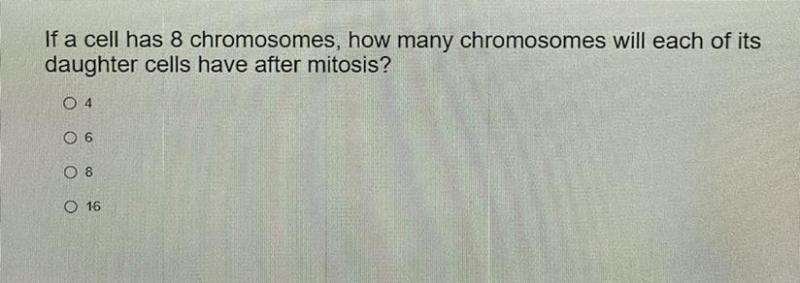
Mitosis is the cornerstone of eukaryotic life, a process so fundamental that its disruption can be fatal. At its core, mitosis ensures that each daughter cell at the end of mitosis contains the same number of chromosomes as the parent cell, maintaining genetic continuity. In humans, this means 46 chromosomes (23 pairs), but the principle applies universally: diploid organisms produce diploid daughter cells, while haploid organisms (like yeast) produce haploid ones. The consistency isn’t just numerical—it’s a testament to the evolutionary pressure to preserve genetic integrity.The process begins with a single cell containing its full chromosomal complement. During prophase, chromosomes condense and pair with their homologues (in diploids), while the mitotic spindle forms. By metaphase, chromosomes align at the metaphase plate, ensuring equal distribution. The separation of sister chromatids in anaphase and their enclosure in new nuclei during telophase guarantee that each daughter cell at mitosis’s conclusion receives an identical set of chromosomes. This symmetry is non-negotiable; even minor errors can have catastrophic consequences, from developmental defects to systemic diseases.
Historical Background and Evolution
The discovery of mitosis in the 19th century revolutionized biology. Walther Flemming, a German biologist, first described the process in 1882, observing the behavior of chromosomes under the microscope. His work laid the groundwork for understanding how many chromosomes are in each daughter cell at the end of mitosis, revealing that cells divide their genetic material with surgical precision. Later, Theodor Boveri and Walter Sutton (1902–1903) proposed the chromosome theory of inheritance, linking mitosis to Mendel’s laws of heredity.Evolutionary biology later clarified why this mechanism persists. Multicellular organisms rely on mitosis for growth, tissue repair, and asexual reproduction. The process’s fidelity ensures that every cell—whether in a human liver or a fern leaf—retains the species-specific chromosome count. Even in unicellular eukaryotes like Paramecium, mitosis guarantees genetic stability across generations. Without this precision, life as we know it couldn’t exist, making the answer to how many chromosomes are in each daughter cell at the end of mitosis a biological constant.
Core Mechanisms: How It Works
Mitosis is divided into four phases, each critical to ensuring the correct chromosome count in daughter cells. Prophase begins with chromatin condensation into visible chromosomes, while the nuclear envelope breaks down. The mitotic spindle, composed of microtubules, extends from centrosomes to capture chromosomes. By metaphase, chromosomes align at the cell’s equatorial plane, a checkpoint (the spindle assembly checkpoint) verifying attachment before progression.Table of Contents
- The Complete Overview of How Many Chromosomes Are in Each Daughter Cell at the End of Mitosis
- Historical Background and Evolution
- Core Mechanisms: How It Works
- Key Benefits and Crucial Impact
- Major Advantages
- Comparative Analysis
- Future Trends and Innovations
- Conclusion
- Comprehensive FAQs
- Q: Why is the chromosome count in daughter cells after mitosis always the same as the parent?
- Q: What happens if mitosis doesn’t distribute chromosomes equally?
The decisive moment arrives in anaphase, when cohesin proteins holding sister chromatids together are cleaved, allowing them to separate and migrate to opposite poles. This pull ensures that each daughter cell at the end of mitosis receives one chromatid from each chromosome pair. Finally, telophase and cytokinesis complete the division, forming two genetically identical daughter cells. The entire process is orchestrated by regulatory proteins like cyclin-dependent kinases (CDKs), which synchronize DNA replication with cell cycle progression.
Key Benefits and Crucial Impact
The stability of mitosis underpins nearly every biological system. From embryonic development to wound healing, the process ensures that tissues maintain their genetic identity. In medicine, understanding how many chromosomes are in each daughter cell at the end of mitosis is vital for diagnosing conditions like trisomy 21 (Down syndrome), where an extra chromosome results from mitotic errors. Even in oncology, therapies targeting mitotic spindle formation (e.g., taxanes) exploit the process’s vulnerabilities to halt cancer cell division.The economic and societal impact is equally profound. Agricultural biotechnology relies on mitosis to propagate genetically uniform crops, while regenerative medicine harnesses stem cells’ mitotic potential to repair damaged tissues. Without the precision of mitosis, cloning—whether of plants or animals—would be impossible. The process is so fundamental that its disruption has ripple effects across ecosystems, from microbial communities to human populations.
"Mitosis is the invisible hand of life, ensuring that every cell, from the first zygote to the last neuron, carries the same genetic instructions. Its failure is the failure of the organism itself." — Bruce Alberts, former Editor-in-Chief of Science
Major Advantages
- Genetic Consistency: Ensures every daughter cell receives the exact chromosome count of the parent, preserving species-specific traits across generations.
- Growth and Repair: Enables organisms to expand, replace damaged cells, and maintain homeostasis through precise tissue regeneration.
- Disease Prevention: Mitotic checkpoints detect and repair errors, reducing the risk of aneuploidy and associated disorders like cancer.
- Evolutionary Stability: The fidelity of mitosis allows for gradual genetic changes (via mutations) without catastrophic loss of genetic material.
- Biotechnological Applications: Forms the basis for cloning, tissue culture, and genetic engineering, where controlled cell division is essential.
Comparative Analysis
| Process | Chromosome Count in Daughter Cells |
|---|---|
| Mitosis (Somatic Cells) | Diploid (e.g., 46 in humans, identical to parent cell). Each daughter cell at the end of mitosis maintains the original number. |
| Meiosis (Gametes) | Haploid (23 in humans), halving the chromosome count for sexual reproduction. |
| Binary Fission (Prokaryotes) | Single circular chromosome replicated and distributed equally (no true "chromosomes" as in eukaryotes). |
| Mitotic Errors (e.g., Nondisjunction) | Variable (e.g., trisomy or monosomy), leading to genetic disorders. |
Future Trends and Innovations
Advances in live-cell imaging and CRISPR technology are illuminating mitosis’s intricacies. Researchers are now mapping the 3D dynamics of spindle formation and identifying new checkpoint proteins that could be targeted for therapies. In regenerative medicine, induced pluripotent stem cells (iPSCs) offer a glimpse into harnessing mitosis for organ repair, while synthetic biology aims to engineer cells with programmable mitotic controls.The field is also exploring "mitotic memory," where epigenetic marks influence daughter cell fate, potentially revolutionizing our understanding of aging and disease. As we decode these mechanisms, the answer to how many chromosomes are in each daughter cell at the end of mitosis may evolve from a static number to a dynamic process—one that adapts to environmental cues and therapeutic interventions.

Conclusion
Mitosis is more than a biological process; it’s the invisible architecture of life. The fact that each daughter cell at the end of mitosis contains the same chromosome count as its parent is a marvel of evolutionary engineering, ensuring stability across trillions of divisions. From the first mitotic event in an embryo to the last in a dying cell, this process is the linchpin of growth, repair, and heredity.Yet, its precision is fragile. Errors in mitosis underlie many diseases, and its disruption can have cascading effects. By understanding this process—its mechanics, its historical significance, and its real-world applications—we gain not only scientific insight but also a deeper appreciation for the delicate balance that sustains all living things.
Comprehensive FAQs
Q: Why is the chromosome count in daughter cells after mitosis always the same as the parent?
A: Mitosis is a tightly regulated process with multiple checkpoints (e.g., the spindle assembly checkpoint) that ensure sister chromatids separate evenly. DNA replication in the S phase produces identical copies, and the alignment in metaphase guarantees each daughter cell receives one chromatid from each chromosome pair, maintaining the diploid number.
Q: What happens if mitosis doesn’t distribute chromosomes equally?
A: Unequal distribution (nondisjunction) leads to daughter cells with abnormal chromosome counts (aneuploidy). In humans, this can cause miscarriages, developmental disorders like Down syndrome (trisomy 21), or cancer if cells bypass checkpoints. The body often eliminates severely affected cells, but some survive and proliferate.
Q: How does the chromosome count differ between mitosis and meiosis?
A: Mitosis produces daughter cells with the same chromosome number as the parent (diploid in humans: 46). Meiosis, however, reduces the count by half (haploid: 23) to create gametes (sperm/egg) for sexual reproduction. This halving ensures fertilization restores the diploid number.
Q: Can environmental factors affect the number of chromosomes in daughter cells?
A: While mitosis itself is highly regulated, environmental stressors (e.g., radiation, chemicals, or extreme temperatures) can damage DNA or spindle fibers, increasing the risk of errors. For example, exposure to mutagens may lead to nondisjunction or chromosomal breaks, altering the expected chromosome count.
Q: Are there organisms where the chromosome count in daughter cells varies after mitosis?
A: Most eukaryotes maintain a stable chromosome count, but some exceptions exist. For instance, certain plants (e.g., Tradescantia) exhibit polyploidy, where cells have multiple sets of chromosomes due to failed cytokinesis. In fungi, some species undergo "mitotic slippage," producing aneuploid cells under stress, though this is often lethal.
Q: How is the chromosome count verified in daughter cells after mitosis?
A: Scientists use techniques like fluorescence in situ hybridization (FISH) to label chromosomes and confirm their number post-mitosis. Time-lapse microscopy tracks spindle formation and chromatid separation, while genetic sequencing can identify structural abnormalities in daughter cells. These methods ensure the fidelity of the process.
Q: What role does mitosis play in cancer?
A: Cancer arises when cells bypass mitotic checkpoints, allowing uncontrolled division. Mutations in genes like p53 or BRCA1 disrupt the process, leading to aneuploidy and genomic instability. Therapies like taxanes target mitotic spindle formation to halt cancer cell proliferation, exploiting mitosis’s vulnerabilities.
Q: Can stem cells divide via mitosis indefinitely?
A: Most somatic cells have a limited mitotic lifespan due to telomere shortening (the Hayflick limit). However, embryonic and some adult stem cells (e.g., hematopoietic stem cells) can divide mitotically for extended periods, maintaining their pool. This self-renewal is critical for tissue regeneration but can also contribute to cancer if regulation fails.
Leave a Comment
Comments are moderated before appearing. The data you submit is processed according to the Privacy Policy of Bevvy.