Decoding the Mystery: What Is the Area Code of 844 and Why It Matters
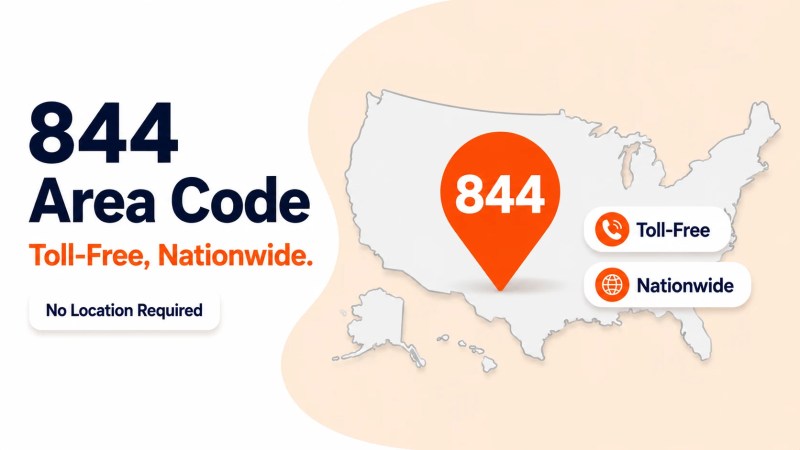
When you dial 844, you’re not connecting to a specific geographic region. Unlike traditional area codes like 212 for New York or 310 for Los Angeles, 844 doesn’t map to a city or state. Instead, it’s a toll-free prefix—a numerical gateway designed to streamline customer service, marketing, and business operations across the United States. The confusion arises because toll-free codes like 800, 888, and 877 are often mistaken for local or regional identifiers, but 844 serves a distinct purpose: it’s part of the North American Numbering Plan’s (NANP) toll-free pool, allocated to reduce congestion in other prefixes and improve call routing efficiency.
The adoption of 844 reflects a broader evolution in telecommunications. As demand for toll-free services surged—driven by e-commerce, customer support, and telemarketing—the Federal Communications Commission (FCC) introduced new prefixes to distribute the load. By 2014, 844 entered service as one of several "new" toll-free codes (alongside 833, 855, and 866), designed to prevent exhaustion of existing prefixes. Companies now use it interchangeably with 800 or 888, but its technical role differs subtly: while older codes like 800 are tied to legacy systems, 844 leverages modern routing protocols to optimize call distribution.
The proliferation of toll-free numbers like 844 isn’t just about convenience—it’s a response to the digital economy’s demands. Businesses rely on these prefixes to project professionalism, scale operations, and manage customer interactions without geographic limitations. Yet, the lack of a physical "home" for 844 raises questions: How does it function? Why was it created? And what does it reveal about the future of phone systems?
The Complete Overview of What Is the Area Code of 844
The area code 844 is a toll-free prefix under the North American Numbering Plan (NANP), meaning calls made to it are free for the caller, regardless of location. Unlike traditional area codes, which denote regional boundaries, 844 is a virtual identifier—its sole purpose is to facilitate seamless, cost-free communication for businesses and consumers. This distinction is critical: while you might associate 212 with Manhattan or 415 with San Francisco, 844 has no geographic anchor. Its existence is purely functional, serving as a tool for enterprises to centralize customer service, sales, and technical support under a single, memorable number.The introduction of 844 in 2014 was part of a strategic move by the FCC to address a growing problem: the depletion of available toll-free numbers. As companies expanded their digital footprints, the demand for toll-free lines outstripped the capacity of established prefixes like 800 and 888. By allocating 844 (alongside 833, 855, and 866), the FCC ensured continued availability while maintaining compatibility with existing infrastructure. This wasn’t just about adding new codes—it was about preserving the integrity of the NANP, a system that has underpinned North American telecommunications for decades.
Historical Background and Evolution
The concept of toll-free numbers traces back to 1967, when AT&T introduced the 800 prefix to simplify long-distance calling for businesses. The idea was revolutionary: customers could dial a single number to reach a company, and the call would be billed to the recipient, not the caller. This model became the backbone of customer service, telemarketing, and even political campaigns. However, as usage exploded in the 1990s and 2000s, the 800 prefix began to show signs of strain. The system was designed with a finite pool of numbers, and by the early 2010s, exhaustion was imminent.To mitigate this, the FCC launched the "Toll-Free Numbering Pool Expansion" initiative in 2010, introducing new prefixes like 833, 844, 855, 866, 872, and 888. The goal was twofold: first, to distribute the load across multiple codes and prevent any single prefix from becoming overburdened; second, to future-proof the system for emerging technologies like VoIP (Voice over Internet Protocol) and cloud-based phone services. 844, in particular, was positioned as a modern alternative, offering the same toll-free benefits as its predecessors but with enhanced routing capabilities. Its debut in 2014 marked a pivotal moment—not just for telecommunications, but for how businesses interact with their customers.
Core Mechanisms: How It Works
When you dial a number starting with 844, your call doesn’t follow the traditional geographic routing of a local area code. Instead, it enters the toll-free network, where advanced switches and databases determine the destination. The process begins with your local phone carrier, which recognizes the 844 prefix and forwards the call to a central toll-free switching center operated by a provider like Verizon, AT&T, or a third-party vendor. These centers use a combination of SS7 signaling (a protocol for real-time communication) and database lookups to identify which business or organization owns the specific 844 number.Table of Contents
- The Complete Overview of What Is the Area Code of 844
- Historical Background and Evolution
- Core Mechanisms: How It Works
- Key Benefits and Crucial Impact
- Major Advantages
- Comparative Analysis
- Future Trends and Innovations
- Conclusion
- Comprehensive FAQs
- Q: Can I get a phone number with the 844 area code?
- Q: Is calling an 844 number really free?
- Q: Why do some companies use 844 instead of 800 or 888?
- Q: Can I trace or block calls from an 844 number?
- Q: Are 844 numbers available internationally?
- Q: How does an 844 number differ from a regular area code?
- Q: Can I port an existing 800 or 888 number to 844?
- Q: Why does my phone show "Unknown" for an 844 number?
The key innovation behind 844 lies in its integration with modern telephony systems. Unlike older toll-free codes, which relied on legacy infrastructure, 844 numbers can be dynamically assigned and rerouted based on demand. This flexibility is crucial for businesses using cloud-based PBX (Private Branch Exchange) systems or virtual phone services. For example, a company might assign its 844 number to a call center in Texas today and reroute it to a remote team in Florida tomorrow—without changing the number itself. This dynamic allocation ensures scalability and cost efficiency, two critical factors in today’s fast-paced business environment.
Key Benefits and Crucial Impact
The adoption of 844 and similar toll-free prefixes has reshaped how businesses engage with customers. For companies, the primary advantage is accessibility: a toll-free number like 844 removes barriers to communication, allowing customers to call without incurring long-distance charges. This is particularly valuable for e-commerce brands, subscription services, and customer support teams, where a single point of contact can drive loyalty and reduce churn. Beyond convenience, 844 numbers also enhance branding. A memorable, easy-to-dial number (e.g., 844-MY-COMPANY) can improve recognition and trust, while the toll-free nature signals professionalism and reliability.The economic impact of toll-free numbers like 844 extends beyond individual businesses. By reducing the administrative burden of managing multiple local numbers or international dial-in options, companies can allocate resources more efficiently. For consumers, the benefit is clear: free access to support, sales, or information—regardless of their location. This symmetry between business and customer needs has cemented toll-free numbers as a cornerstone of modern commerce. As one telecommunications expert noted, "The success of prefixes like 844 isn’t just about the numbers themselves—it’s about the trust they enable between brands and their audiences."
"Toll-free numbers like 844 are more than just digits—they’re a bridge between companies and their customers, built on the principle that access to service should never be a financial barrier."
— Jane Whitaker, FCC Telecommunications Analyst
Major Advantages
- Universal Accessibility: Calls to 844 numbers are free for the caller, regardless of their location within North America. This eliminates cost concerns for consumers and encourages engagement.
- Scalability: Businesses can assign 844 numbers to multiple departments, locations, or even international teams without changing the dial-in number, simplifying global operations.
- Brand Consistency: Using a single toll-free prefix (e.g., 844 for all customer service lines) reinforces brand identity and reduces confusion for repeat callers.
- Integration with Modern Tech: 844 numbers seamlessly integrate with VoIP, cloud PBX, and AI-driven call routing, enabling features like interactive voice response (IVR) and call analytics.
- Future-Proofing: As older toll-free prefixes (like 800) face depletion, 844 offers a sustainable alternative, ensuring businesses can continue using toll-free numbers without disruption.
Comparative Analysis
While 844 shares similarities with other toll-free prefixes, key differences in routing, availability, and use cases set it apart. Below is a comparison of 844 with other major toll-free codes:| Prefix | Key Characteristics |
|---|---|
| 800 | Oldest toll-free prefix (since 1967). Limited availability due to high demand; often used for legacy systems. Geographic routing possible in some cases. |
| 844 | Modern prefix (since 2014) with no geographic ties. Optimized for VoIP and cloud services. High availability and dynamic routing. |
| 888 | Introduced in 1997 to relieve 800 congestion. Still widely used but facing depletion. Some numbers may route to specific regions. |
| 833 | Newest prefix (2014), designed for government and non-profit use. Limited commercial adoption compared to 844 or 888. |
Future Trends and Innovations
The role of 844 in telecommunications is poised to evolve alongside broader industry shifts. As businesses increasingly adopt AI-driven customer service—such as chatbots and predictive routing—toll-free numbers like 844 will serve as the entry point for these advanced interactions. Imagine dialing 844-MY-BANK, only to be connected to an AI agent that resolves queries in real time, or a virtual assistant that transfers you to a human agent only when necessary. The integration of 844 with emerging technologies like 5G and edge computing could further reduce latency, making toll-free interactions faster and more responsive.Another trend is the globalization of toll-free services. While 844 is currently limited to North America, similar systems are being adopted in other regions (e.g., 0800 in the UK, 1800 in Australia). This could lead to cross-border toll-free numbering plans, allowing businesses to maintain a single, unified customer service number across multiple countries. For 844, this might mean expanding its use in Canada or even piloting international toll-free routing. The challenge will be balancing innovation with the need to preserve the simplicity and trust that toll-free numbers like 844 have come to represent.

Conclusion
The area code 844 is more than a sequence of digits—it’s a testament to the adaptability of telecommunications infrastructure. By addressing the limitations of older toll-free prefixes, 844 has become a vital tool for businesses seeking to connect with customers without geographic or financial constraints. Its design reflects a deeper truth about modern communication: the most valuable numbers are those that disappear into the background, enabling seamless interactions. As technology advances, 844 will continue to play a pivotal role, not as a relic of the past, but as a dynamic enabler of the future.For consumers, understanding what is the area code of 844 clarifies why their calls to customer support are free and why businesses can scale effortlessly. For enterprises, it’s a reminder that the right phone number isn’t just about reach—it’s about reliability, branding, and the ability to innovate without friction. In an era where every second of customer interaction matters, 844 stands as a quiet but powerful ally in the pursuit of connection.
Comprehensive FAQs
Q: Can I get a phone number with the 844 area code?
A: Yes, businesses and individuals can obtain 844 numbers through telecommunications providers like AT&T, Verizon, or specialized VoIP services. These numbers are assigned on a first-come, first-served basis, and availability varies by region and provider. Unlike traditional area codes, 844 numbers are not tied to a physical location, making them ideal for customer service lines or business hotlines.
Q: Is calling an 844 number really free?
A: Yes, calls to 844 numbers are toll-free for the caller within North America. The recipient (e.g., a business) pays for the call, just as they would with an 800 or 888 number. This policy applies to landlines, mobile devices, and VoIP services, though international calls to 844 numbers may incur charges.
Q: Why do some companies use 844 instead of 800 or 888?
A: Companies opt for 844 primarily to ensure long-term availability. Older prefixes like 800 and 888 are nearing exhaustion, while 844 offers a fresh pool of numbers with modern routing capabilities. Additionally, 844 can be more cost-effective for businesses using cloud-based phone systems, as it integrates seamlessly with VoIP and AI-driven call management tools.
Q: Can I trace or block calls from an 844 number?
A: Like any toll-free number, 844 calls can be traced through your phone provider’s call logs or by using reverse lookup services. Blocking is also possible via carrier settings (e.g., iPhone’s "Silence Unknown Callers" or Android’s spam filters). However, legitimate businesses using 844 numbers for customer service should not be blocked unless they’re identified as spam.
Q: Are 844 numbers available internationally?
A: Currently, 844 is restricted to North America (U.S., Canada, and some Caribbean nations). However, similar toll-free prefixes exist in other regions (e.g., 0800 in the UK, 1800 in Australia). If you’re outside North America, you may need to use a local toll-free number or an international dial-in service to avoid charges.
Q: How does an 844 number differ from a regular area code?
A: Unlike traditional area codes (e.g., 212 for New York), 844 has no geographic association. It’s a toll-free prefix designed for business use, meaning:
Q: Can I port an existing 800 or 888 number to 844?
A: No, you cannot directly port an existing 800 or 888 number to 844. However, you can purchase a new 844 number and set up call forwarding or IVR to redirect calls from your old number to the new one. This is a common practice during rebranding or when transitioning to a more modern phone system.
Q: Why does my phone show "Unknown" for an 844 number?
A: If an 844 number appears as "Unknown" or "Private," it’s likely because:
Leave a Comment
Comments are moderated before appearing. The data you submit is processed according to the Privacy Policy of Bevvy.